
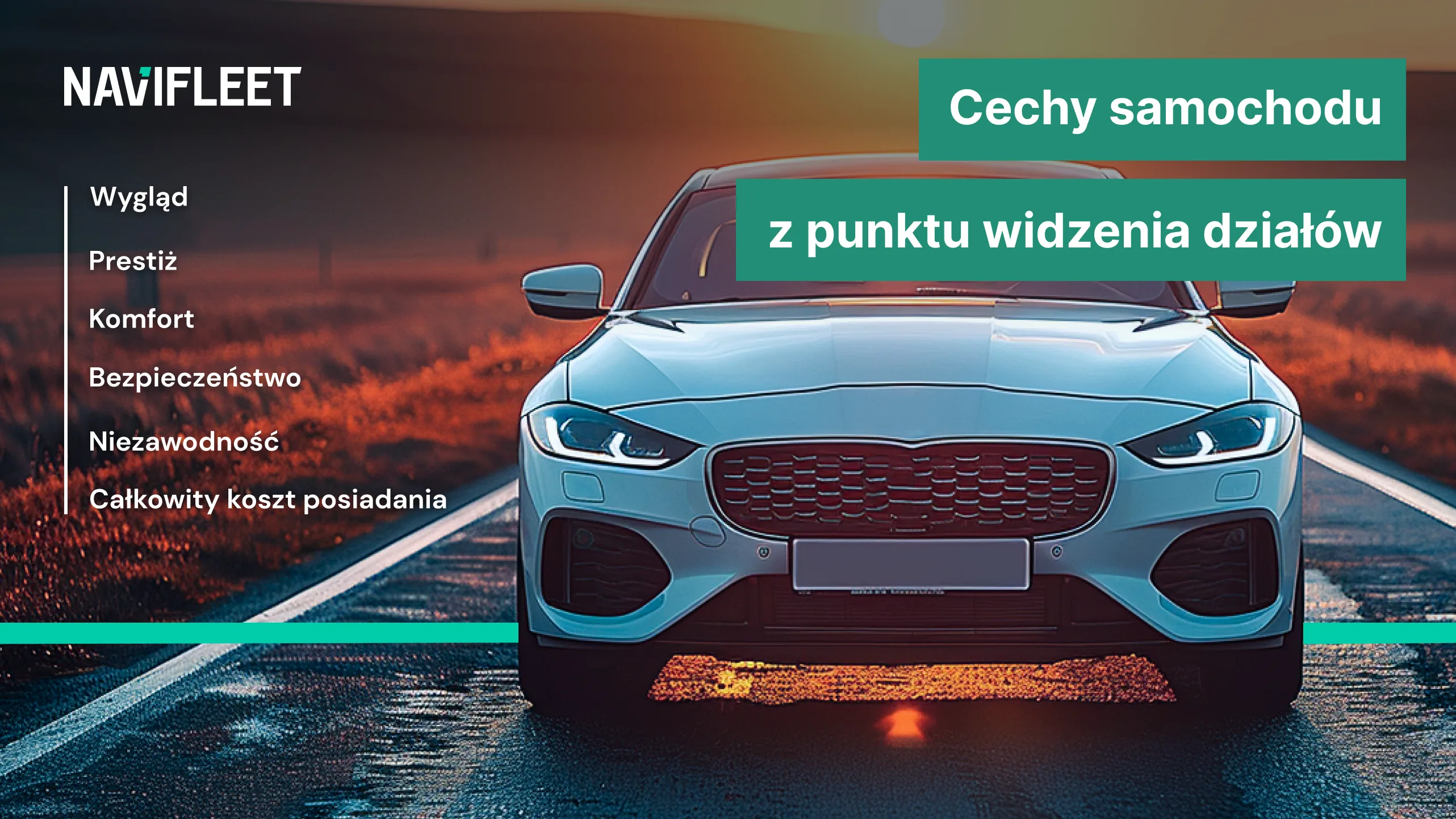
The ideal company car does not exist. Why? What should a company car close to the ideal be like? This is a question all fleet managers often ask themselves. Today we take a close look at the individual characteristics of company cars from the point of view of the different departments in a business.
A company car should be matched as closely as possible to its needs and purpose: we will choose one car for a senior manager, another for a sales rep travelling across the whole country, and yet another for a service technician operating within a single region. For this reason alone we can say there is no ideal, universal company car, and that is a very obvious statement. In this article, however, I intend to analyse in depth the individual characteristics of a company car, such as the level of passive and active safety, total cost of ownership (purchase, fuel consumption and running costs), reliability, comfort and ergonomics, and appearance and prestige.
Active and passive safety
There is no doubt that looking after the safety of company car users should be a priority for every fleet manager and company board. Safe cars are an asset for the HR department in recruitment as well as reducing the risk of accidents at work. Choosing cars known and valued in this respect for the fleet will also affect the company's image, so this factor may matter to the PR/marketing department. Of course, regardless of department, all users will be interested in safety. When choosing cars for the fleet, Euro NCAP reports can be used. Minimum requirements should also be set for the safety systems a company car must be equipped with.
Total cost of ownership (TCO)
The company fleet is one of the most significant cost factors, so a thorough assessment and control of costs in this area has a very significant impact on the profitability of the business. TCO will be one of the most important factors for the board and the finance/controlling department. It should be stressed that TCO depends not only on the purchase cost and the cars' fuel consumption but also on their residual value, servicing costs, failure rate and insurance rates.
Reliability
The durability and reliability of company cars is very important, indeed beyond dispute. It will obviously matter to the fleet manager: a lower failure rate in the fleet means fewer worries, less work and fewer problems to solve. For the other departments it means above all fewer disruptions to work related to possible limits on users' mobility caused by a car breakdown. This characteristic of a company car will also matter to the accounting department (every company car fault may result in additional accounting documents) and to the legal department, especially in the case of serious breakdowns leading to legal disputes over the scope of liability. Today, decision-making should not be guided by stereotypes. Globalisation, unification and the optimisation of production costs mean that the same notorious engines can often be found in cars from different manufacturers. When assessing a car's reliability, rely on reports from objective institutions such as TÜV or Dekra, taking into account the specific model and engine version. Moreover, reliability depends to a large extent on looking after the cars' technical condition, above all through regular servicing.
Comfort and ergonomics
These characteristics of a company car will matter most to users, regardless of the department they work in. They can also be an additional asset for the HR department in recruitment. Assessing this parameter when choosing cars for the fleet can be difficult because comfort is a very subjective and individual concept. For users who drive a lot, the driver's seat is the most important thing: adjustment ranges, contouring, softness/firmness and dimensions. A car can be assessed more objectively in terms of comfort-enhancing equipment. While air conditioning is standard today, there are still many features and factors that improve comfort, such as a heated steering wheel, ventilated seats or active suspension. Good practice is to define which comfort-enhancing equipment will be treated as standard and which users will be entitled to depending on their position.
Appearance and prestige
Besides users, these characteristics will usually be of interest to the PR/marketing department, given its role in creating the company's image. Through the right choice of company cars, company traits such as innovation and originality, conservatism and credibility, or functionality and accessibility can be emphasised. The fleet's role in creating the company's image is so important that the board is often directly involved in the decision-making process, setting certain threshold criteria.
Summary
As I mentioned at the outset, there is no ideal company car. When considering the choice of the right cars for the fleet, you should first ask yourself which of the characteristics above matter most and rank your priorities accordingly. You can then hold internal consultations with the departments indicated. Involving them at a suitably early stage will help avoid criticism later.
 Luba Kurek
Board member of the Polish Association of Fleet Managers; Head of Administration and Fleet Manager at PHZ Baltona S.A.
Luba Kurek is an experienced fleet management specialist who has worked in the automotive industry and motorsport for many years. At PHZ Baltona S.A. she heads the Fleet Management and Administration Department and sets the direction for the fleet's development. She is the author of numerous industry articles in which she shares her knowledge and insights.



