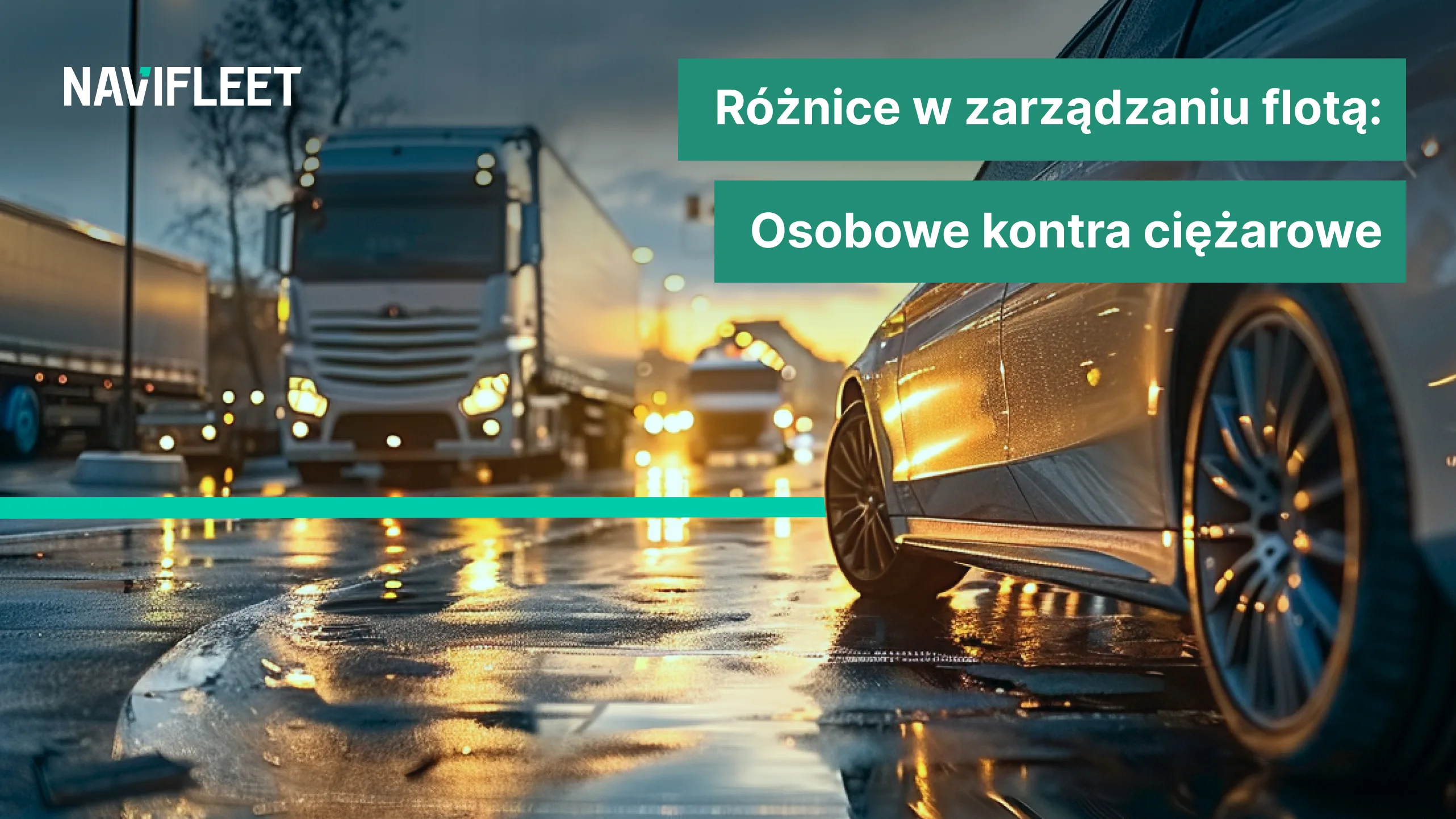
Administering a fleet of motor vehicles is a broad field of management that requires specialist knowledge and skills, as well as adapting management methods to the specific needs of a particular industry and the organisational structure of a given company. In my career in vehicle management so far, I have had the chance to work with fleets of varying needs, shapes and uses, from tractor units to passenger cars. In this article I would like to share my observations, pointing out the differences in how individual vehicle fleets are administered.
The role of the fleet administrator
An employee looking after a car fleet in most cases handles it comprehensively. Their responsibilities include administrative tasks related to vehicle documentation (insurance, leasing/fleet management contracts, fines and correspondence, etc.), decision-making tasks related to taking part in negotiations on vehicle purchases and telematics and shaping the fleet policy, as well as technical tasks related to handing vehicles over to users, making decisions on repairs and, often, personally delivering and collecting vehicles from workshops. This type of manager is characterised by multitasking and extensive general knowledge of vehicle operation. In car fleets, the specialist responsible for them often also receives other tasks not directly related to cars, while being part of a separate department in the company. Their responsibilities then depend on where they sit in a given division. For example, a fleet manager in the administration department may handle areas such as managing company property in the role of facility manager, or may deal with more general office tasks such as keeping company records, organising meetings, office supplies, mobile phone administration or statistical reporting to the national statistics office (GUS). In the logistics department, on the other hand, this might be organising external transport, coordinating deliveries to the warehouse or ongoing administrative support for the warehouse. The large number of non-fleet tasks often results from the relatively small size of the fleet, as a result of which the person managing it has enough time to support other activities of the company. It also happens that fleet management is only a fraction of the working time of the person responsible for it, so it is handled on the side by office administration staff, or its management is split between several people, each responsible for a specific slice of it.
Working with a truck fleet is, in my personal experience, associated with a higher level of specialisation in a specific area of fleet management. This is because the number of operations related to handling documents, permits, equipment and many other things per vehicle is naturally far greater than for cars. Remember, too, that with heavy vehicles the fleet is divided not only into powered units such as tractor units but also unpowered ones such as semi-trailers, which naturally increases the number of units under our care.
So into which areas can we divide fleet work for heavy vehicles?
- Administrative area: covering activities related to the ongoing handling of fleet documentation: vehicle registration, insurance policies, monitoring vehicle deadlines, compiling vehicle files, managing the driver database, co-creating the fleet policy, and cooperating with the road transport inspection authorities (ITD).
- Settlement area: settling business trips and driver working time, handling leasing contracts from a settlement perspective, handling fuel cards, settling cost invoices and verifying vehicle-related charges, settling vehicle taxes.
- Technical area: handling everything physically and directly related to the vehicles, for example dealing with breakdowns, working with mechanical workshops on repairs and parts selection, ordering accessories and load securing equipment, handing over and collecting vehicles from drivers, checking technical condition, looking after the consumables store, and supervising the on-site fuel tank.
- Decision-making area: covering all activities related to negotiating insurance contracts, fuel card and telematics providers. This area is also responsible for market analysis and decisions on investing in new vehicle combinations based on customers' changing transport needs. In smaller companies, all these matters are often handled by the owner, who does not involve the fleet's operational staff in negotiations but decides for themselves which vehicles to buy and how to finance them.
The above is a very general division. Its shape in individual companies depends on the size of the fleet and the organisational structure of the business. The larger the fleet and the more extensive the structure, the more specialised the division of duties among the staff looking after the vehicle fleet. It is worth adding that the issues listed above are only the most important points.
It happens that truck fleet staff also perform other tasks beyond those directly related to vehicles, but I believe this occurs relatively less often and there are fewer of them than in car fleets.
Telematics and its use
Car and truck fleets differ significantly in their technological needs when it comes to telematics, which stems from different technical conditions as well as their purpose in the company.
The main telematics needs in car fleets, beyond positioning, involve supporting administrative activities such as driver identification or marking the type of journey as private or business. Light fleet management systems often use gamification and competition between employees, which helps integrate them and improve their driving skills. The choice of installation method for the devices also often comes up. Two approaches are considered: quick and simple installation in the OBD port, or direct connection with a hook-up to the CAN bus.
With trucks, we do not have to wonder how to identify the driver. The systems are connected directly to the tachograph, so the person driving the vehicle is identified by their driver card. Thanks to the connection between telematics devices and the tachograph, the systems can serve the company's operational needs in carrying out transport orders. These may be modules such as a route planning tool, a system analysing the driver's available working time, remote download of tachograph data (DDD files), or advanced systems supporting the transmission of transport orders to the driver, improving communication between dispatcher and driver. Eco-driving gamification is also less common, and for obvious reasons there is no need to identify private journeys.
Looking for common ground between the two fleets, it is worth mentioning features that allow fuel consumption analysis, invoice import, modules for managing deadlines, damage and cost records, as well as options related to POIs and geofences.
Driver training
When it comes to employee training, we will certainly find common ground for both fleets, but there will also be certain elements characteristic of each group. For example, in the context of improving economical driving, a popular form of training for cars is sessions organised in urban traffic or on a track, bringing together a larger group of trainees. The company therefore has to organise this event at the right place and time so as not to disrupt current commitments to customers while tying up a significant number of employees on a single day. The training is most often run by an external specialist who conducts the session for the whole group.
With trucks, a fairly common practice is to pair weaker drivers (for example in terms of fuel consumption) with better ones, who act as trainers and receive a pay supplement for it. This does not turn current plans upside down (provided the company uses two-driver crews), and the fleet manager's task is ongoing analysis of whether such measures will bring the desired results. Another popular practice is organising training on the use of driver assistance systems, run by the brand's dealer when new vehicles are collected. Drivers who have come to collect the trucks then have the chance to get to know the brand's technological innovations through a few hours of theoretical and sometimes practical training, which does not usually happen when new cars are collected.
With internal induction training organised by the company, however, we find a common denominator. In both cases the employee needs to be familiarised with the company's vehicles, shown the servicing rules, introduced to the systems and applications the company uses in connection with driving, and the new driver needs to be made familiar with the fleet policy and their obligations under it.
Working with vehicle users
Cooperation between fleet manager and driver often differs between the fleets compared.
In the transport industry, a large group of drivers today are foreign workers, particularly from Eastern Europe. Because of this, communication is not an easy element, given that these drivers often do not speak Polish well and fleet managers, for example, do not speak Ukrainian. Potential communication problems can hinder the fleet manager's effective work, both in internal communication with the driver and in the driver's contacts with external parties. For example, there were times when a driver had a communication problem on arriving at a customer for unloading and could not reach an understanding with the staff there about resolving the issue, which meant I had to resolve these often simple matters, which took up my attention and pulled me away from other tasks. If there is no communication barrier, however, cooperation on vehicle operation can run smoothly, because the driver knows the vehicle's operation inside out. Thanks to their experience, they can often solve minor problems and carry out ad hoc repairs themselves. This avoids the need to call out roadside assistance and involves the fleet employee minimally (only reporting the fault and how it was resolved, so that they know what to check when the vehicle returns to the depot).
On the other hand, with employees who use cars, communication is much easier, because they are usually Polish employees or people whose position requires a good command of our language. It is worth noting, however, that unlike professional drivers, they usually have only basic knowledge of vehicle operation and, despite induction training, call with questions about matters that are easy and obvious to the fleet manager but not necessarily to users. One example is an employee calling because they do not know what to do when an information light comes on on the dashboard (e.g. top up AdBlue), or they are often unable to describe a fault in their vehicle accurately. Matters like these are usually easy to resolve, but they also take time and require stepping away briefly from current tasks.
In describing the point above, I had no intention of pigeonholing anyone, only of pointing out certain recurring patterns in particular types of fleet. The quality of communication depends on both sides, and here too fleet staff should work on themselves.
Moving between industries
Moving from managing a heavy transport fleet to running a car fleet involves certain challenges. For a fleet manager changing area in this direction, the key will be adapting to a range of new tasks that may not be directly related to vehicle management. When considering a change, it is worth carefully checking and verifying the actual scope of duties and considering whether any side tasks will match your professional development direction. In terms of the fleet itself, however, acclimatising to daily work with cars, although it requires some adjustment, should not cause major problems.
In the reverse situation, when moving from managing a car fleet to administering a heavy transport fleet, bear in mind that issues will arise that did not exist with lighter vehicles. If the fleet manager had not previously taken an interest in this type of fleet themselves, they had no opportunity to gain specialist knowledge in their previous job. A move in this direction will certainly broaden the fleet manager's horizons considerably, but the ways and methods of working will require a longer adaptation than would be the case the other way round.
Summary
That the management mechanisms are somewhat different is clear at first glance. Both industries bring a range of challenges specific to them. For this reason, a definitive choice as to which of them is more complicated to manage makes little sense. It is also worth noting that this article has considered only general comparisons between a fleet in a transport company and a sales fleet. There are many other models, such as fleets using special vehicles, which are characterised by different challenges and technological needs. Personally, I believe that work in this profession is fascinating precisely because of such great diversity and the differences between industries.