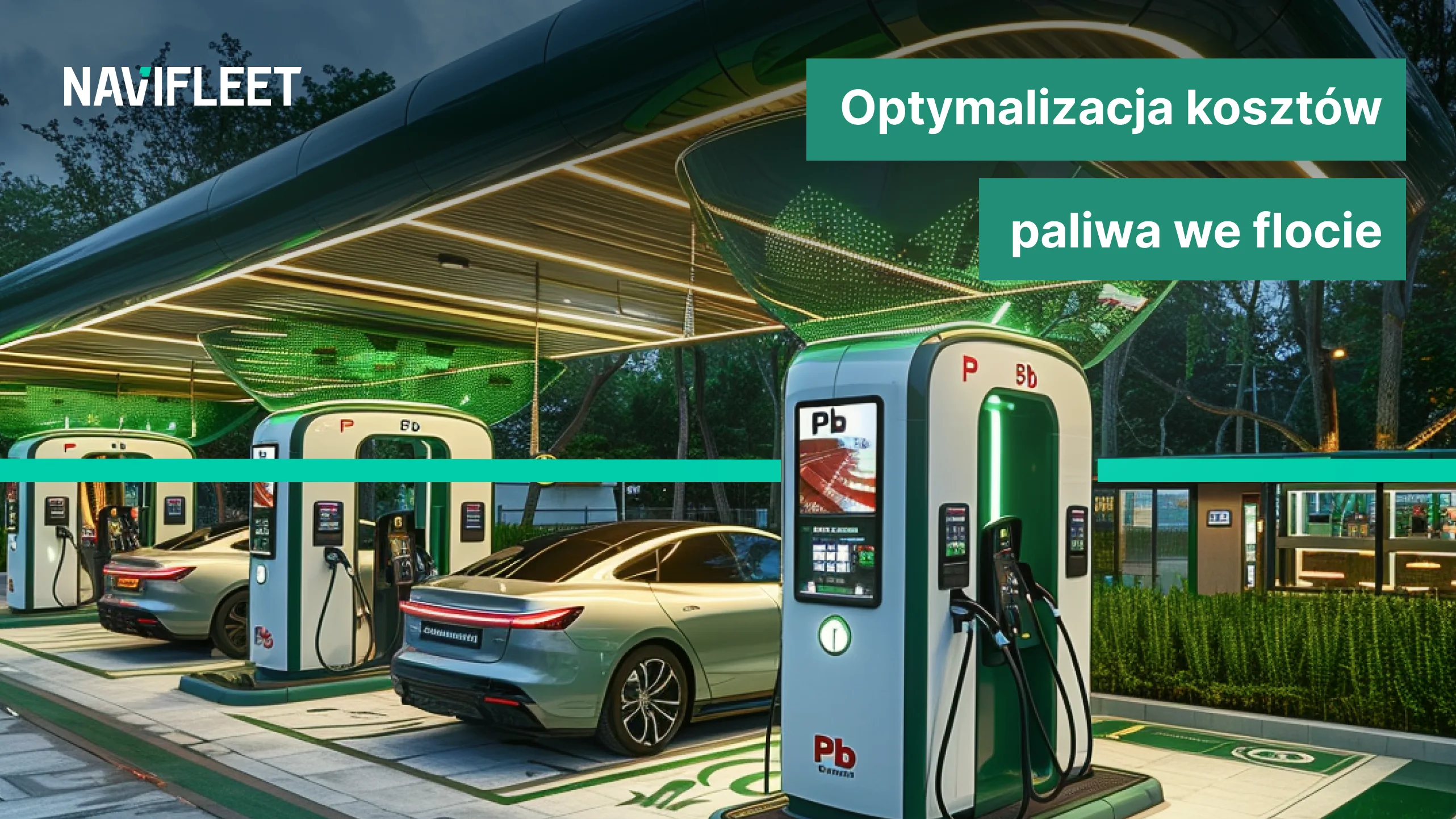
Fuel-related costs are one of the biggest expenses for any company with its own vehicle fleet. Whether we are talking about sales, service or transport companies, optimising this spending is key to improving operational efficiency. It is therefore worth looking at the tools and strategies that can help.
Fuel cards
Fuel cards, often called fleet cards, are tools that allow vehicles to be refuelled without cash. This kind of solution has a number of advantages that streamline cost management. The cashless nature of the payment means the company pays a single consolidated invoice for a given period covering the refuelling of all its vehicles. As a result, the fleet manager does not have to enter each refuelling as a separate cost in the fleet system. Instead, they can easily import the data into the system and automatically assign individual refuellings to specific vehicles, allocating cost centres at the same time. This streamlines the cost entry process and makes it easier to analyse whether the refuelling of individual vehicles is justified.
In addition, using telematics systems, the fleet administrator can compare the number of litres of fuel on the invoice with the amount detected by the CAN bus or a probe in the fuel tank. Large discrepancies raise questions about their causes. They may indicate that the employee put some of the fuel into another (possibly private) vehicle or a jerry can. Such checks make it possible to quickly detect and explain potential abuse or errors, which increases control over refuelling and improves cost management in this area.
Staying with fleet cards, it should be noted that merely having such a tool is a cost for the business. When administering the cards you hold, and when choosing a provider, it is therefore worth paying attention to the following matters:
- Which stations does the provider cover? With well-known providers practically every station will authorise payments, but if for some reason we opt for a less popular solution, this is worth bearing in mind.
- What is the service mark-up on individual transactions? During the analysis you should check which services the provider applies the highest mark-up to. I mean checking the mark-up on refuelling with a given type of fuel, on AdBlue and on other services. These parameters should be compared with the existing cost structure in your fleet.
- What are the conditions for receiving discounts when refuelling at particular stations? You also need to ask what volume is required to obtain a given discount and whether that is achievable in the fleet you manage.
- It is also worth checking when the last attempt was made to negotiate with the card provider on the level of discounts and mark-ups. Perhaps since the last talks there have been changes in the fleet you manage that could favourably affect these parameters.
Refuelling policy
Staying on the subject of refuelling, the fleet policy must not be overlooked in this context. A properly constructed fleet policy can significantly affect the management of refuelling and contribute to savings in this area. What should you look at when formulating the fleet policy in this area?
1. Designating the filling stations where refuelling is allowed
This is worth considering especially when you have managed to agree a specific level of discount at a particular station with the fleet card provider. Admittedly, fleet discounts usually amount to a few pence per litre, but economies of scale can generate visible savings.
2. Designating the type of fuel to be used
Employees with company cars quite often decide to fill the cars they drive with premium fuel. Although this is often good for the fuel system, it obviously generates higher costs than filling up with regular fuel. It is therefore worth analysing the situation in your fleet and deciding to ban or limit the number of premium refuellings per month, or to specify the types of vehicles in which it is allowed (e.g. very expensive board members' vehicles).
3. Foreign refuelling policy
For fleets with frequent business trips outside Poland, it is worth creating appropriate refuelling procedures. The reason is that the price of fuel outside the country is usually higher. In addition, the service mark-up for using a fleet card for foreign refuelling will probably be higher than usual, and discounts for refuelling at a particular station will not apply or will be relatively lower, especially at the start of trips to a given country (without the required refuelling volume in a given country you will not get a discount). When travelling abroad, however, there is no way to avoid refuelling.
Below are a few procedures that help minimise the cost of foreign operations:
- a requirement to fill up in Poland before crossing the border: this kind of solution gives us certainty that just after crossing the border into a foreign country we will not be forced to refuel at an unfavourable price. Perhaps a full tank will be enough to get the job done and return home.
- the last refuelling abroad only up to the amount needed to reach Poland: the idea is that the last foreign refuelling before returning home should only allow the driver to reach Poland, with the rest of the fuel topped up after crossing the border. Yes, this can be tiresome for the employee, and yes, it steals extra minutes for another refuelling. But I recommend looking into it, because for fleets that frequently travel between a given country and Poland, savings can be achieved by applying this solution.
- analysis of the fleet card market in foreign countries: it is worth analysing the fleet card market in the countries employees travel to often. Perhaps introducing an additional fleet card dedicated to a given country will prove the answer. An alternative may be to negotiate with the domestic provider to harmonise service mark-ups and to fight for discounts at foreign stations. To achieve this, however, we must show increased refuelling volume in the specific country.
Tyre condition
Pressure loss increases the tyre's rolling resistance, which forces the vehicle to generate more energy to get moving, and that translates into higher fuel consumption. It might seem that a slight shortfall in pressure is no cause for concern. In reality, a loss of 0.4 bar can increase fuel costs by around 3-4% per month. The potential losses from improper tyre pressure can therefore run to several thousand, and for heavy fleets with a large number of rigs even over ten thousand PLN a month.
What can you do about it?
Make tyre inspection a regular item in the calendar. If your fleet is one where the vehicles come back to base, I recommend adding a TI (tyre inspection) date for each vehicle with an interval of no more than 3 months, and the more often the better. That way you will always know when the last check took place and when it is worth checking the tyres (both their technical condition and the pressure). If, on the other hand, you see the vehicles relatively rarely, I recommend handing this task over to the drivers, with a requirement to report the results within a set time.
Cruise control
Sudden changes in engine speed increase the car's energy expenditure. Maintaining steady revs by using cruise control is very important for optimising fleet costs. Most people are happy to use this system, but some drivers are reluctant. Despite numerous benefits not directly related to cost, such as greater driving comfort and reduced fatigue, some drivers remain sceptical about cruise control and other assistance systems. When asked why they do not use cruise control, I have often heard the reply "I have cruise control in my foot", especially from older, experienced drivers. So what can we do, and how can we even detect which drivers use this feature and which do not?
What can you do about it?
- Verify engine speed data using the information provided by the CAN bus. By analysing telematics data, we can easily trace the history of a journey and work out whether the driver used cruise control at specific moments by observing the engine speed chart for a given section.
- A reward system for economical drivers. It is worth introducing a benefits system for drivers who generate savings through economical driving. The motivation of a reward may persuade previously reluctant employees to start using cruise control.
Route planning
Proper route planning obviously has a very big impact on fuel consumption. A lack of control over the planning of a driver's daily schedule can cause a considerable rise in fuel costs. Below are two popular tools worth considering in the context of route management:
1. Task planner
Depending on the industry and the system used, planners of this kind work in different ways. For example, in the municipal services industry such planners work with waste containers fitted with RFID tags. Based on the schedule and the information from the tags, the system automatically assigns tasks to specific employees. It eliminates unnecessary stops and routes that do not need to be done on a given day, which translates into lower fuel costs as well as less working time. Tasks can also be set manually by a supervisor and sent to employees, who are required to report the status of the task. Such solutions make management easier and help determine the order of customer visits in sales and service industries.
2. Route corridors
This is a tool gaining popularity in telematics systems, particularly in the transport industry. The system involves the route being set for the driver by the person in charge (the forwarder, dispatcher or transport manager). Once the route has been prepared, its parameters are sent to the device installed in the vehicle, which works with the TMS. As a result, the driver follows the designated route almost to the letter. Provided the route is properly planned by a specialist, the company can save not only fuel but also significantly reduce other operating costs, such as motorway tolls. It is also worth adding that if the driver deviates from the route, the person in charge is informed immediately. The system is based on geofencing technology, informing the relevant person when the designated area has been left.
Driving style analysis systems
Another important factor in reducing fuel costs is systems that analyse drivers' driving parameters. Using data from the CAN bus or the OBD diagnostic port (depending on the GPS system chosen), the fleet administrator can receive information such as:
- fuel consumption,
- harsh braking,
- harsh acceleration,
- engine speed data,
- idling time.
With this information the fleet manager can identify drivers' bad habits and tailor training programmes to employees' specific needs. In addition, the information obtained can indicate whether a given group of vehicles meets the fuel consumption assumptions made when they were purchased, or whether a change of make or type of vehicle for specific tasks needs to be considered.
Summary
Fuel cost optimisation is an extremely broad subject and there is no way to cover everything in a single article. Depending on the type of business and the company's financial capacity, we can also consider other solutions such as investing in our own fuel tank (bulk orders mean significant savings), ultrasonic probes, advanced driver assistance technologies and much more. The ideas above are only some of the actions a fleet manager can take to look after the fleet budget. I recommend not taking them as black and white, but treating them as a kind of outline that can be modified and adapted to specific needs and circumstances.