Implementing telematics can seem a major challenge to a fleet manager. Having to get involved on top of a pile of other duties, convincing the board that the project will pay off, and getting sceptical drivers on board are, for many, barriers that cannot be overcome. To meet these needs, we offer a free, no-obligation trial of the Navifleet app with the driving style analysis module. A trial deployment shows the scale of the potential savings and demonstrates that telematics is not another burden for the fleet manager, but a tool that makes managing vehicles easier.
The trial discussed here concerns the Driving Style Analysis module. If you want to find out how this technology works, visit the knowledge base and the blog article Driving style analysis: reduce accidents, costs and the carbon footprint of your fleet.
How does the Navifleet trial with the Driving Style Analysis module work?
First, it is worth stressing that the trial is completely free and comes with no obligation. This means that after 30 days the tester decides for themselves whether to continue on a larger scale or to part ways with Navifleet. As part of the trial we provide three GPS trackers: one for the fleet manager, so they can get to know our technology better, and two for selected drivers (the best and the worst, in the fleet manager's opinion). Choosing the drivers at the two ends of the fleet manager's subjective ranking is intended to show how large the differences in fuel consumption, mistakes made and driving style in general can be. To keep the process as simple as possible, in trials we use devices that plug into the cigarette lighter socket, and they are handed over under a loan agreement.
The basis for an effective trial deployment is setting its goal. Here we focus on the user's needs and their knowledge of their fleet. With this information and an understanding of what our technology can do, we define together with the user a realistic goal for the month-long trial. This might be a 5% reduction in fuel consumption or an improvement in driver scores in a chosen category. There are many such variants and they are chosen individually.
Before the trial starts, it is important not to forget to engage the drivers properly. Above all, they need to be introduced to the Navifleet Driver app, which for the next 30 days will inform them about the mistakes they make and display driving style suggestions. They also need to be told what will be assessed and how. Reassurance about privacy protection (in line with GDPR rules) is also essential.
During the trial the user has access to the knowledge and support of their Navifleet account manager. This means they can consult them without restriction on any aspect they have doubts about. The preferred approach is to arrange regular meetings with Navifleet consultants, who will help run the whole process effectively and verify the ongoing results. In this way the fleet manager gets to know the driving style analysis technology better, which is, after all, one of the purposes of the trial.
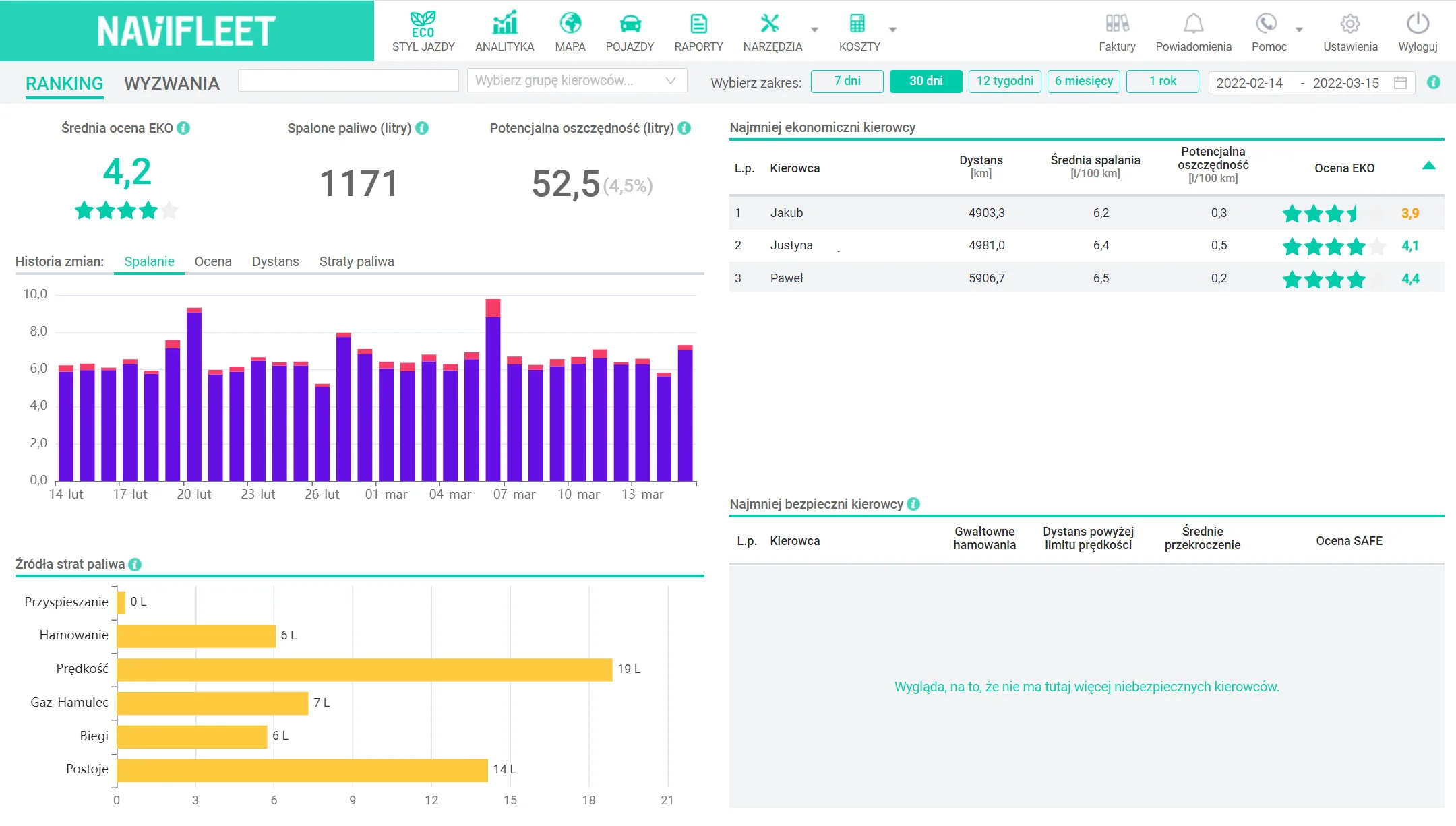
During the trial, the fleet manager uses dedicated rankings and charts to monitor their drivers' progress, checks how this translates into fuel consumed and engages employees ad hoc in challenges they create themselves. This requires minimal involvement and will certainly not disrupt the rhythm of the working day. You can read more about how to verify drivers' progress in our knowledge base.
What do you gain from the Navifleet trial?
The thirty-day trial brings out the advantages of telematics perfectly. Above all, the user receives measurable data on the savings generated over the past month. On this basis it is easy to calculate the potential gains for the whole fleet over a full year of using the telematics system. Hard numbers are certainly something that will interest the board.
Savings calculation: the best way to convince the board to adopt telematics – in this article we showed what such an analysis might look like.
After thirty days of the trial there is also a noticeable change in the drivers' attitude to the telematics system. After such a test they see for themselves that technology analysing their driving style can help them eliminate bad habits behind the wheel and, as a result, drive more safely and economically. What is more, thanks to the private mode feature, they stop seeing modern telematics technology as a means of surveillance.
The fleet manager, meanwhile, will see that automating certain processes with telematics is an excellent way to make their work easier. We are convinced that some duties are worth entrusting to technology.
Summary
It is important to remember that improving driving style is a continuous process. Even so, we can guarantee that after the thirty-day trial the fleet will record its first savings. We know from experience that this is the factor that led most former testers to become regular users of the Navifleet app with driving style analysis technology.

Contact me if you want to start generating savings in your fleet.
Piotr Wójcik
New Business Manager