This article covers Polish regulations and market practice. The principles apply elsewhere, but check the rules in your country.
GPS tracking is an excellent way to streamline fleet management and generate savings. Implementing a telematics system in a company, however, raises doubts for employers and employees alike. One of them is the legal aspect of such a project. The GDPR and GPS tracking in the work regulations are the main headaches when implementing a telematics system. We decided to explain the basics.
How does GPS in a company car work?
The principle of GPS tracking is simple. The GPS tracker receives a signal from a satellite. The device sends the collected data over the GSM network to the tracking operator's server. There the information is processed and then presented in the app.
In this way the fleet manager has control over the vehicle's location in real time. Advanced telematics systems can also send data from the vehicle's CAN bus in addition to location data.
GPS in a company car: the benefits for the fleet manager
Tracking in a company car solves many of the fleet manager's problems. In most cases GPS tracking itself is only the foundation of a much more complex telematics system. With telematics, many fleet processes happen automatically. The fleet manager's daily multitasking becomes simpler.
Depending on the solutions chosen, telematics lets the fleet manager:
- keep a virtual service book with automatic reminders of inspection dates and so on,
- control refuelling and fuel spending,
- generate savings by improving drivers' driving style,
- protect the privacy of drivers who use company vehicles for private purposes,
- identify drivers using pool vehicles.
GPS in a company car and the GDPR: what do the regulations say?
What is the link between GPS in a company car and the GDPR? Under the EU General Data Protection Regulation, we should be informed in detail about how and why the following data is processed:
- first name and surname,
- national identification number (PESEL),
- address and contact details,
- ID card number,
- and other characteristics that allow a natural person to be identified (e.g. physical, cultural, social or economic characteristics).
GPS in a company car, as a form of employee monitoring, is subject to the above rules. Geolocation data is personal data because it leads to driver identification. The employer must therefore reckon with meeting one of two obligations: informing employees about GPS tracking, or obtaining their consent to implementing such a system. Which option applies to you is explained in the following paragraphs.
Do employees have to know about GPS fitted in a company car?
The information obligation is an integral part of the GDPR. In the case of GPS tracking, the driver must be informed of the introduction of this type of monitoring no later than 2 weeks before it starts. How do you inform an employee about GPS in the car? It can be done by means of a notice with an appropriate record. The information should cover who will process the data, what rights the employee has and for how long the collected location data will be stored. Once the data archiving period has passed, the data must be deleted. The employee must be informed of this.
By law, GPS in a company car also requires the vehicles subject to monitoring to be labelled (no later than one day before the monitoring starts). This can be done with stickers. In addition, every new employee must be familiarised with the above matters before starting work.
Does an employee have to consent to the use of GPS in a company car?
A company vehicle is often also an employee benefit, which means they can use it outside working hours for private purposes. If we also intend to monitor journeys unrelated to the employee's work duties, we must obtain their consent. Such a document must clearly state that the employee consents to the processing of data by their employer, i.e. the data controller.
The solution to this problem is the Navifleet system, which comes with a private mileage mode. It is our answer to the needs of fleet owners and drivers.
Private mode in the Navifleet app protects drivers from having their private journeys tracked, while for fleet managers it is a tool for settling them. In the Navifleet Driver mobile app, the driver can switch freely between private and business mode (provided the fleet manager granted them that permission when creating the driver profile in the Navifleet system).
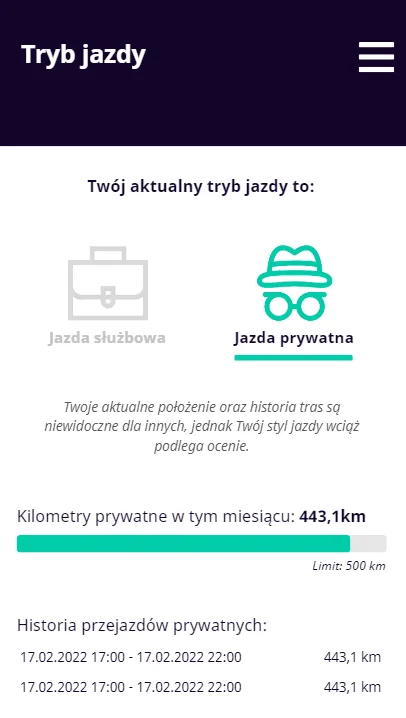
Once private mode is switched on, the fleet manager cannot see the vehicle's current position. In addition, data from private journeys is anonymised in the route history, reports and notifications.
Once the Navifleet system with the private mode function is implemented, drivers stop seeing telematics as a form of surveillance. In that case, from a GDPR perspective, the driver's consent to fitting a GPS tracker is not required. It is still necessary to inform employees that GPS tracking is being introduced into the fleet.
The private mode function has one more advantage. It makes it easier for the fleet manager to settle private journeys. In companies where vehicles are an employee benefit, a limit on free kilometres driven for purposes other than business is usually applied. To verify these limits, we have added the option of generating a private mileage report in the Navifleet app. This way, at the end of the month, the fleet manager can create such a summary, analyse it and total up a given employee's journeys. Transparent calculation is the basis for effective, fair cooperation between employer and driver.
If you want to learn more about private mode in the Navifleet app, visit our knowledge base: Private mode in the Navifleet app.
What are the rules for the employer collecting and using data?
The Polish Labour Code allows the lawful use of fleet vehicle monitoring only where the employer has a specific justification. Most often this is ensuring the proper use of vehicles as work tools (e.g. in line with eco-driving principles) or ensuring the organisation makes full use of working time.
GPS monitoring of employees without an advanced telematics system gives the employer the ability to collect data on the vehicle's current and possibly historical position. Such data may be used only for the purposes mentioned above.
Navifleet, as the provider of a modern telematics system, offers much more. Yes, our solution is based on GPS vehicle tracking, but that is only the foundation for a wide spectrum of possibilities. The Navifleet platform includes functions such as fuel control (using fuel cards and a dedicated probe) and integration with the SENT and e-TOLL systems. Our newest solution is the driving style analysis module. It is an advanced technology that supports drivers in improving their driving style and lets the fleet manager monitor the process. The result of implementing such a solution is lower fuel consumption and a lower claims rate across the fleet, which translates into financial and environmental benefits.
As you can see, the type of data collected and processed can vary. From the vehicle's current location in the simplest systems to engine speed or accelerator pedal position in advanced telematics technologies. That is why it is worth choosing GPS tracking tailored to the company's needs.