Signing a contract with telematics service and fleet management system providers is a key moment in the work of every fleet manager. It is this decision that can determine whether daily duties will be streamlined or whether you will run into numerous difficulties for years to come. Which aspects are worth considering, and what thinking is essential when choosing the right solution?

Defining the company's hierarchy of needs as a starting point
Why start by defining your needs and weighting them? In an ideal world it would be easy to find a system that meets all our expectations. In reality, it is certain that there will be compromises. Decide what matters most in your view, taking into account the specifics of the industry you work in and the board's requirements for your work. Expectations and needs can differ widely. To highlight the importance of this point, below I illustrate an example hierarchy of needs for two different companies.
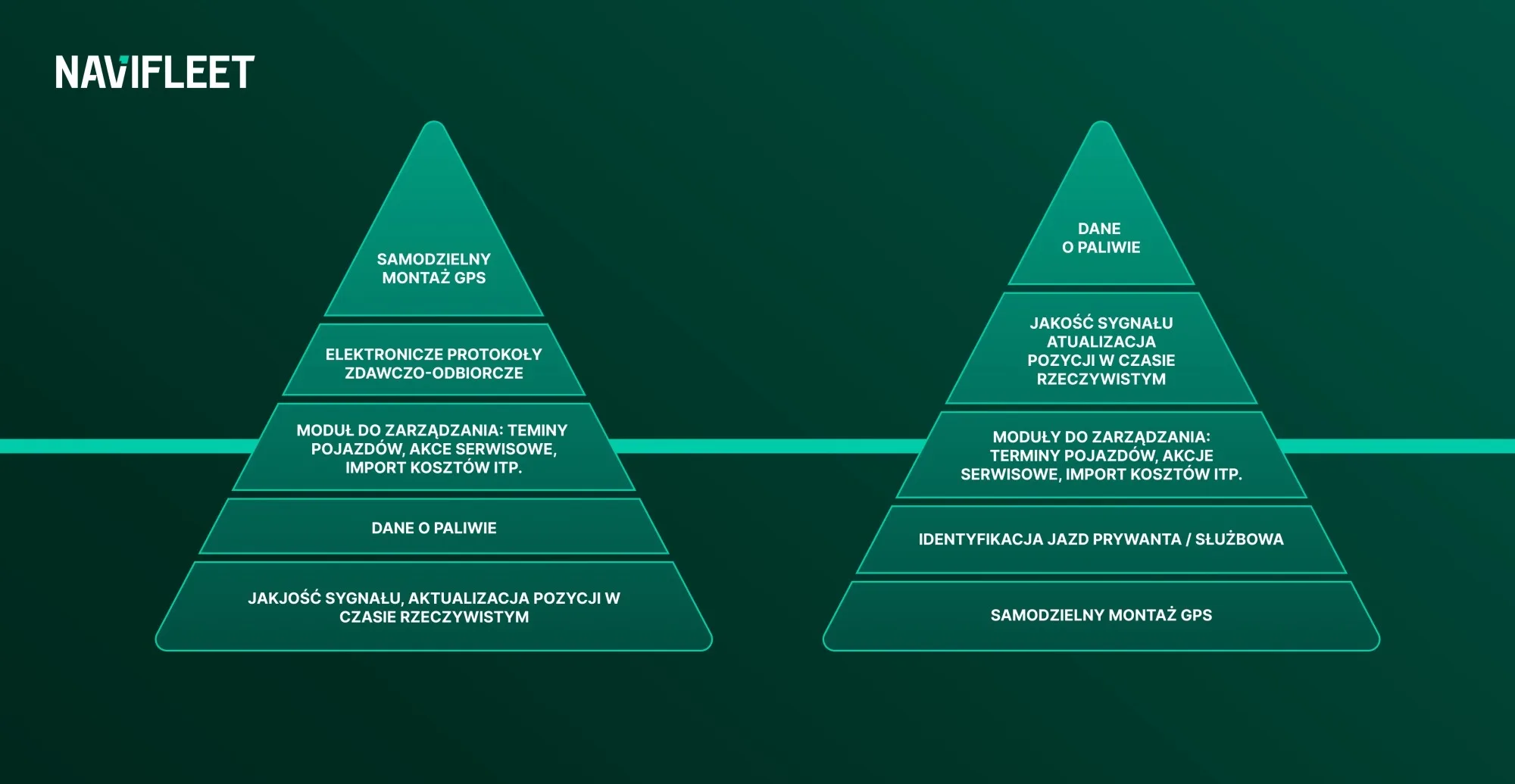
It seems counter-intuitive, but not all companies put the quality of the GPS system first over additional features. What is more, some would even say that other, secondary features are more important. I will talk about them later on.
The test phase and collecting offers
Once your needs are defined, the search for providers and the test phase begin. At this stage it is worth creating a single comparison of all the systems tested, listing the features that correspond to your hierarchy of needs and the remaining additional options. The comparison should be built so that it brings the tested systems down to a common denominator as far as possible. The simplest way is to create a shared table, assigning a weight to each feature and scoring it. Weighted-average comparisons can always carry slight distortions due to poorly calibrated weights. I suggest using this kind of score as a reference point rather than the "final oracle" on which decision to make. When building such comparisons, take into account the different variants a given operator offers.
At this stage it is worth considering the following questions:
- Are the features we originally deemed essential actually essential?
- If you already have a system and are testing a new solution, it is a good idea to ask yourself: will the new provider broaden your fleet management capabilities while retaining the existing features you use with your current provider? If not, consider whether it will really be a change for the better.
- Will the costs of the individual modules generate savings (both in time and in money)?
- What does the cost structure for maintaining the system look like in relation to the planned budget? At this point you should also take into account the company's growth strategy and any changes to the fleet.
- Will the provider ensure installation of the devices at every location you require?
Details worth paying attention to
CAN vs. OBD
As I mentioned at the outset, choosing a system will involve the art of compromise. This is exactly the decision you have to make when weighing up installing the tracker in the OBD port against a solution with the device wired directly into the CAN bus. Both systems have a range of advantages and disadvantages. Below is a table comparing the capabilities and risks of implementing each solution:
Purchase vs. rental
Weighing up purchase against rental should not be as much of a puzzle as the question of installation method above. Everything rests primarily on your confidence in the quality of the hardware and software in use and on calculating whether and when such an investment could potentially pay off. Remember that if you decide to buy, you will still pay a subscription for access to the system and for the SIM cards in the tracker. Please also bear in mind that every device eventually breaks down, and the scope of the warranty in these cases is usually quite limited. When deciding to buy, we must be aware of possible unexpected costs of replacing devices during the year, which we do not face with rental (if the devices are not mechanically damaged, they are usually replaced without any problems). It is also obvious that before deciding to buy, rental seems the most sensible option for the first contract. The risk of buying devices straight after the test phase is being left with unsatisfactory hardware and software that you do not know what to do with.
Private/business journey identification and logging in to the vehicle
So far I have come across three solutions for logging in and identifying journeys. One is buttons in holes drilled into the vehicle's dashboard. When the button was pressed, the system identified the journey as private. Logging in was done by manually assigning the user to the vehicle in the system. This system caused a lot of problems, especially if users frequently swapped vehicles (it created a heavy workload for the employee operating the system). In addition, interference with the dashboard was received in various ways by new buyers when the vehicle was resold, not to mention situations where the vehicles were due to be returned to the leasing company. Below I propose two solutions that do not interfere with the vehicle and which I suggest considering during tests:
Fleet management: supporting systems
More and more companies that deal only with vehicle positioning are expanding their services with supporting applications. With such solutions you do not have to look for external systems dedicated to fleet management and incur additional costs or, worse for the manager, run everything in spreadsheets. Systems of this type usually include tools such as:
- Cost invoice import and cost centre management,
- Applications for various types of requests from users,
- Car sharing,
- Scheduler,
- Various registers: damage, tyres, certificates, contract parameters, etc.,
- Vehicle handover reports,
- Reports (environmental, statistical, automatic tax returns, VAT reports, etc.).
The solutions above significantly affect the quality and comfort of work of every specialist managing a vehicle fleet and are becoming an essential addition to the GPS services market. It is therefore worth taking into account the scope and costs of these services during testing.
SLA, the clause for hard times
An SLA (Service Level Agreement) is a clause in the main contract concerning the guaranteed level of service, which sets out standards and expectations regarding quality. Such clauses are appearing in contracts more and more often. Below are a few SLA provisions in the context of GPS services:
- System availability: the provider guarantees system availability at a specified level (e.g. 98%). If availability falls below this level, the subscription fee for the month in question is reduced by a specified percentage.
- Response time to a failure: in the event of a device failure, the provider is obliged to remedy the effects of the failure or take on the repair order within a specified time.
- Guarantee of system development: when a company signs a contract for GPS services, it may happen that certain features are still under development but are promised to the tester soon. To protect the customer's interests, the contract may include a provision setting out detailed conditions and deadlines for implementing these features.
Summary
This article has only touched on the most common aspects of choosing a provider and testing GPS services.