This article covers Polish regulations and market practice. The principles apply elsewhere, but check the rules in your country.
One of the absolutely most important documents needed for a vehicle fleet to run smoothly is the driving licence. Every one of our drivers should hold a valid driving licence and notify us as soon as they lose it.
But how should you approach verifying the driving licence, especially once you have started working with a given driver?
Is it appropriate to run spot checks? Or should you check the validity of the licence once a quarter?
Worse still, how do you find out when one of our drivers has lost their entitlement without duly notifying the fleet manager?
In this article we answer these and other questions about employees' entitlement to drive vehicles.
Initial verification of an employee's entitlements
Starting from the beginning: before we start working with a given driver, we must verify their entitlement to drive specific vehicles, depending on the cars in our fleet.
Under the provisions of the Polish Labour Code, an employer has the right to require certain personal data both from job candidates and from employees.
Starting with basic personal data, such as:
- first name(s) and surname;
- date of birth;
- contact details;
- information on education and professional qualifications;
- and information on the prospective employee's employment history to date.
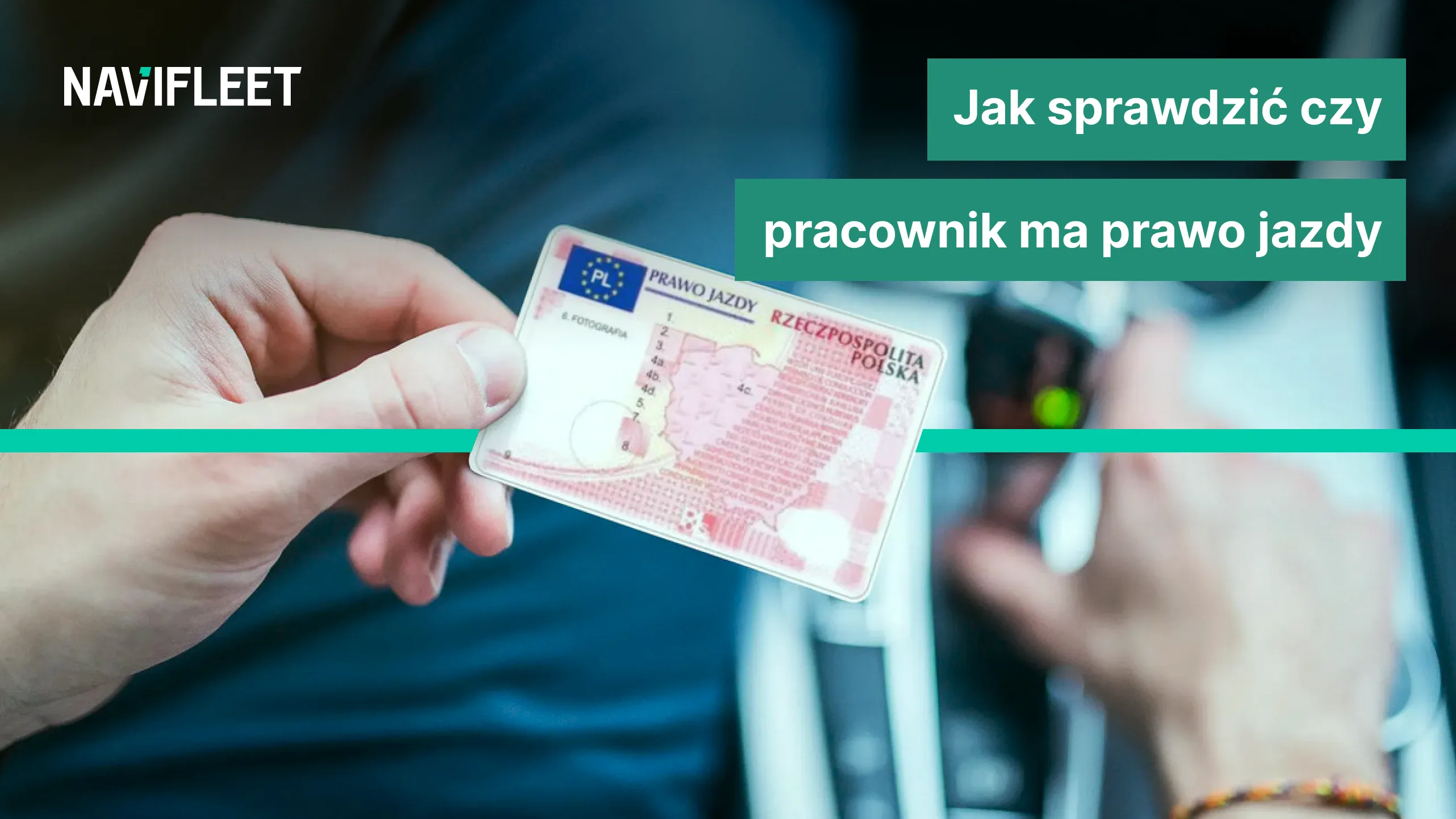
Where it is necessary for employment in a specific position or for performing specific work, the employer also has the right to require the driver to present their driving licence for verification.
A copy of the driving licence
But does the employer have the right to make and keep copies of such a document?
In Poland, an employer has the right to make and keep a copy of an employee's driving licence, but under certain conditions and in specific situations. A driving licence is a document confirming entitlement to drive vehicles, so it can be an important document in the context of employment, especially if the job requires driving (e.g. for couriers).
The condition for an employer to make a copy of a driving licence is compliance with labour law and data protection regulations:
- The employer must have a legitimate legal interest in obtaining such a copy, e.g. if driving vehicles is an essential part of the job.
- Under the GDPR (General Data Protection Regulation), the employer must ensure that data processing complies with the principles of data minimisation, purpose limitation and adequacy.
A safe solution is to ask the employee to present their driving licence "for inspection" only, and at the same time to sign a declaration confirming that they hold a current entitlement to drive vehicles. It is worth including in the declaration a point where the employee gives their driving licence number, which will allow the employer to verify it later in the Central Register of Drivers.
This solution should be considered better from a data protection perspective; after all, we are not storing copies of important documents.
B2B, contracts for specific work and contracts for services
In a sales fleet, it sometimes happens that people work with the employer on a basis other than an employment contract. This may be B2B cooperation, where the driver runs a sole proprietorship, or another type of contract, e.g. a contract for services or a contract for specific work.
In such cases, does the employer have the right to demand that the driver present the document entitling them to drive vehicles?
Whether the driver signs an employment contract, a contract for services or a B2B cooperation agreement with us, when the person's duties include driving a vehicle, the employer may verify their entitlement.
What is more, if we hire a driver with their own car, without providing a company vehicle, we should still verify their entitlement.
💡 In that case, we also recommend concluding an additional agreement on the use of a private car for business purposes, containing the employer's obligation to reimburse the expenses the employee incurs in running the vehicle. That way you systematise the rate per kilometre, compensating the driver for using their private car.
Returning to contracts: every contract, whatever its type, contains provisions. One of them may be a provision obliging the driver to comply with the organisation's internal procedures, including a provision on verification of their entitlement.
The President of the Polish Personal Data Protection Office says:
Where an employee's duties include driving a company vehicle, it may be appropriate for the employer to periodically verify their entitlement in this respect. The employer should, however, define the frequency of such checks, which should be reflected in the regulations in force at the employer.
The legal basis cited for such checks is the provisions of the Labour Code entitling the employer to request necessary data from the employee.
Remember, however, that the employee presenting their driving licence to the employer at the start of cooperation does not rule out the driver losing their entitlement or having their licence temporarily withdrawn in the future.
Hence the rest of our article, on verifying entitlement throughout the cooperation with a given driver.
How to check whether a driver's entitlement is current
One of the fastest and most reliable ways to verify our drivers' entitlement is to check the Central Register of Drivers (CEK).
CEK data can easily be checked on the moj.gov.pl website by entering the key details of the driver being verified, including their first name, surname and driving licence number.
In response, CEK returns:
- the type of document,
- the series and number of the form,
- the document's expiry date,
- the document's status, e.g. whether it has been withheld,
- the type and scope of the entitlement obtained: category and expiry date.
If the document we want to verify is not in the register, we see a message that no such data exists.
Where the entitlement has been revoked or a driving ban has been imposed, the data on the document appears together with a message that the document needs to be checked.
Importantly, the data provided is current as of the register's state on the previous day, updated daily at around 6:00 am.
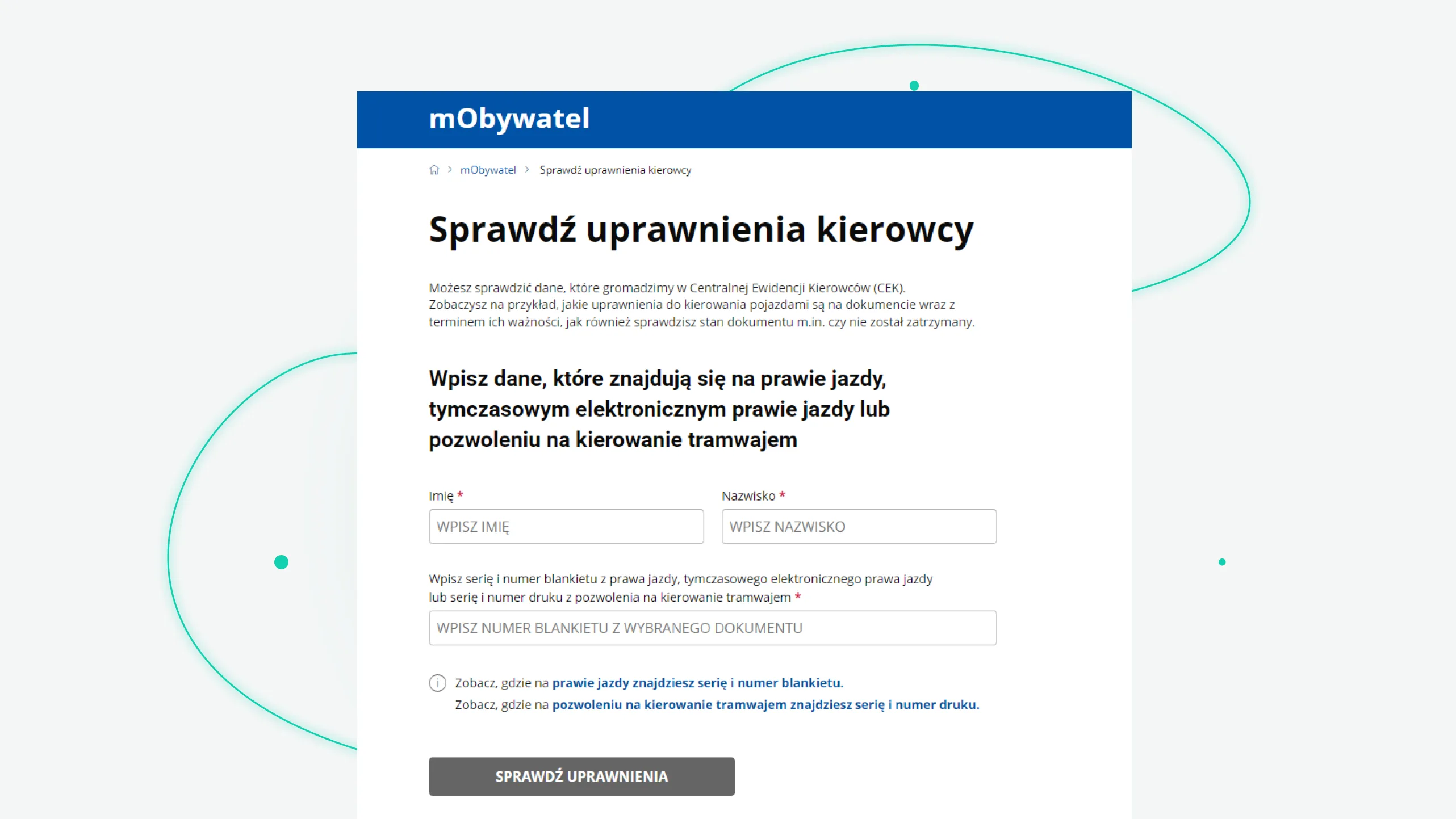
CEK data can be checked free of charge and relatively quickly online.
Importantly, CEK holds data not only on professional drivers but on every driver with a driving licence, which came into force together with the provision that drivers no longer need to carry their driving licence with them.
The amendment to the Road Traffic Act introduced the above provision on 5 December 2020.
Can an employer verify drivers' entitlements periodically?
An employer can certainly verify drivers' entitlements periodically in order to check their entitlement and ensure the whole fleet operates properly.
However, the frequency of periodic checks of drivers' entitlements should be defined in the company's internal regulations or fleet policy.
This may be a specific period, e.g. a quarter, six months or a year, or a provision requiring the relevant entitlement to be presented "on request" by the employer.
An additional safeguard is a provision in the vehicle handover report or in the fleet policy on the driver's obligation to report any changes, such as the loss of the driving licence, revocation of entitlement, or offences or crimes as a result of which a court has banned the driver from driving.
More on important provisions in a fleet policy.
A driver has lost their licence: how do you find out?
If a driver does not inform the employer about losing their driving licence, under the provisions of the Polish Executive Penal Code the employer may still be informed of the fact.
Where a driving ban is imposed, the court sends a copy of the judgment to the relevant government or local government authority for the convicted person's place of residence.
However, if the convicted person drives vehicles professionally, the court notifies the employer with whom the convicted person is employed.
In other cases, when our drivers are not professional drivers and the court is not obliged to inform their employer, we will have to rely on our own verification of entitlements, whether periodic or "on request", depending on the provisions of our fleet policy, work regulations or the contract concluded with the driver.
Importantly, a driver whose driving licence has been withheld or revoked and who has not informed their employer should expect the possibility of summary dismissal for losing the entitlement required for the position held
It is worth noting that termination of the employment contract with notice or by mutual agreement is also possible.
Can a fleet manager prevent drivers from losing their driving licence?
A fleet manager can play an important role in preventing drivers from losing their driving licence, and thus in ensuring employee mobility.
They can do so by:
- monitoring drivers' behaviour using GPS telematics systems and reporting drivers' road incidents. The systems flag dangerous driver behaviour on the road, e.g. not keeping to the speed limit, harsh acceleration and braking. You can learn more about such a solution here.
- controlling claims and monitoring the number of penalty points awarded. With such data, we can draw up a list of employees potentially "at risk" of losing their driving licence.
- installing warning systems that use sound to inform the driver of hazards or offences as they happen, e.g. when speeding or changing lanes incorrectly.
- educating drivers and running safe driving training, which improves drivers' skills and raises their awareness of hazards and good road safety practices.
In addition, it is worth gathering all the most important regulations and rules, and the requirement to observe the traffic rules, in our fleet policy, to which drivers should have easy access.
How to do it better
We all know how much a fleet manager has on their plate, from answering endless phone calls to constantly updating Excel and piles of documents.
Add to that a series of tasks related to preventing the loss of a document as crucial as the driving licence, and we may run out of time for other important matters, such as cost optimisation.
But there is a way to streamline the process of preventing drivers in our fleet from losing their documents: using the right fleet management system.
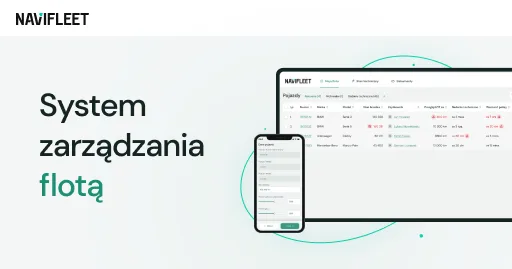
A good example is the Navifleet Manager app, which currently comprises three modules: e-Documents, e-Handover reports and My Fleet.
In the Navifleet app, setting up reminders about the expiry of a driver's document (not just the driving licence) is really simple. We describe the whole process here.
Each of these modules makes a different area of the fleet manager's work easier, including creating handover reports, recording damage, keeping the vehicle register and sharing important documents with drivers.
With a system like Navifleet, we gather in one place several of the activities we should carry out to prevent our drivers from losing their driving licence.
In a single app you can:
- share your fleet policy with your drivers and collect electronic signatures confirming they have read the document,
- share other important documents with your drivers, such as vehicle registration documents or insurance policies, which may be needed in the event of an inspection or collision,
- keep a register of various kinds of data on the vehicles in your fleet, e.g. damage incurred, and easily analyse larger data sets,
- set reminders for important dates, such as inspections, which will help even more to keep vehicles in good condition while preventing unwanted situations.
It is worth stressing that a system like Navifleet Manager does not require a long-term contract. On the contrary, it is available on a monthly subscription, the cost of which depends on the vehicles you add (with no minimum number of cars required).
In addition, you choose which app modules you want to use, paying only for the functions your fleet really needs.
Try the Navifleet Manager app free for 30 days and cancel your subscription whenever you need. No commitment.