Fuel costs in transport companies account for around 40% of the company's total costs. Fuel and refuelling control using a GPS system is easy and does not require much effort on the haulier's part. Based on the experience and tests of many GPS system users, fuel and refuelling control is a very effective way of reducing a company's costs. Below is an article on how to control fuel in a company using a GPS system.
Monitoring the fuel level in the tank
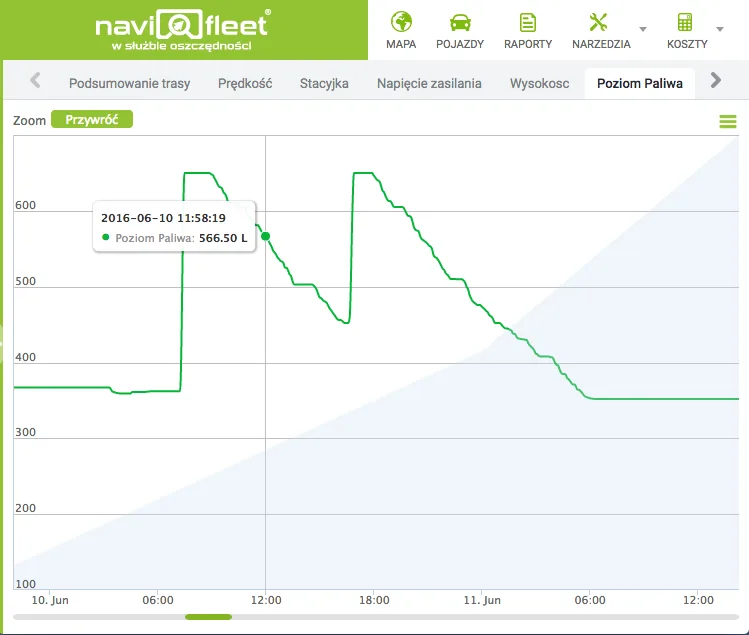
One of the most useful ways of presenting fuel data is a chart of the amount of fuel in the vehicle's tank. The chart is generated automatically so that every refuelling carried out by the driver is recorded. Checking the fuel added with the help of charts allows you to pinpoint exactly where and when the vehicle was refuelled. The user can also assess whether the tank was filled up completely. The fuel level chart also shows fuel loss from the tank. Just click the relevant point on the fuel chart and the GPS system will display the location of the sudden change in fuel level. This feature makes it easy to establish whether the fluctuation in fuel level occurred while driving (as a result of the vehicle's movement) or while parked.
Greater reading accuracy thanks to fuel level and consumption calibration
The optimal source of the data needed to control fuel consumption in a company is the vehicle's on-board computer. Fuel level and consumption data is often provided in an imprecise form. Many factors contribute to this, and the end result is that consumption readings from the on-board computer differ from the vehicle's actual performance. To ensure accurate consumption control, the readings from the vehicle need to be calibrated. Doing so can raise the accuracy of the readings to as much as 99.5%. Precise fuel control in a GPS tracking system requires an individual approach to each case, because the scale of the error (distortion) in the on-board computer's data differs from vehicle to vehicle. Only once the readings have been calibrated can refuelling and consumption control deliver the intended result: a clear picture of the state of the company's fuel economy.
SMS or e-mail notifications when the vehicle is filled up at any station
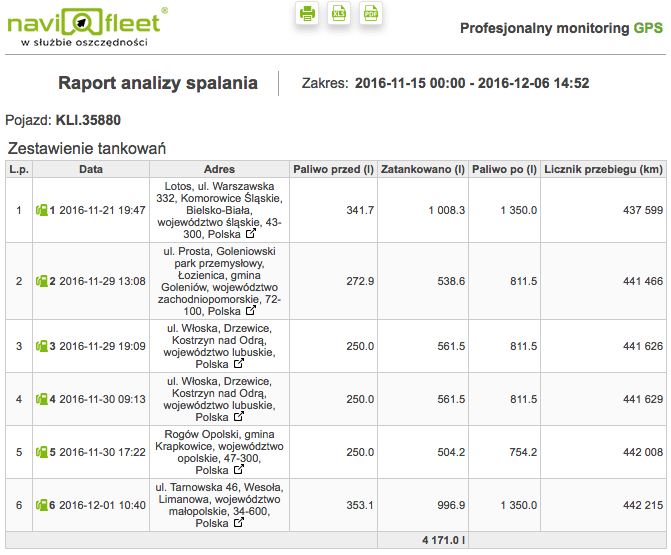
To know about every refuelling, simply configure the appropriate alerts in the GPS system. Fuel control can take place in real time. As soon as the vehicle's tank is filled up, the system sends an SMS or e-mail notification about the event. Thanks to this feature, the user learns about their driver's refuelling before the driver has even left the station. Just log in to the system to check the exact location of the refuelling on the map. The notification log is created automatically, so the user can very easily find out when the driver filled the vehicle up in recent months.
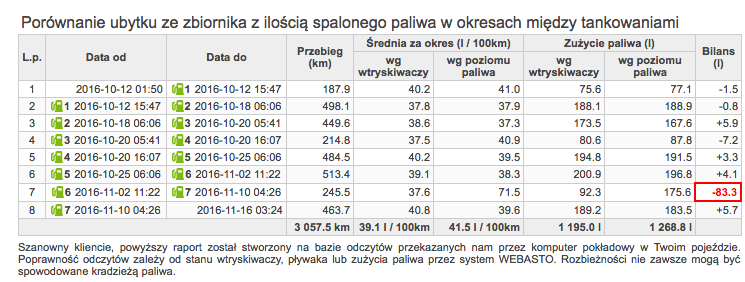
Fuel and loss control. The difference between fuel added and fuel burned by the engine
It is obvious that fuel added to the tank can only leave the vehicle through the engine. How to identify and account for fuel losses? Most vehicles have two sensors: one in the fuel tank, reporting the amount of fuel in the tank, and one in the engine, measuring the amount of fuel delivered directly to the engine's pistons. Put simply, refuelling and consumption control go hand in hand, and the balance of these values should be close to zero. For fuel control in a vehicle to be accurate, all you need to do is generate a consumption and refuelling report. The structure of the report allows you to compare the readings of fuel burned by the engine with the fuel loss from the tank. Anything that was not burned by the engine left the vehicle some other way. If the vehicle is in good technical condition and there are no leaks in the fuel system, the conclusion is self-evident, but every such case should be analysed individually.