The cost of running a vehicle fleet keeps rising. This is particularly evident during periods of rapidly increasing inflation. Remember, however, that how much of our budget fleet costs consume depends to a large extent on our employees' driving style. If we want to reduce the TCO (total cost of ownership) of our vehicles, this is exactly the aspect we should focus on. How can a company cut costs?
Reduce fuel consumption
With rising fuel prices, uneconomical driving hurts more than ever. These days companies do not need a huge fleet of cars to pay a fortune for fuel. Introducing a telematics system into the company is one of the most effective ways of reducing fuel expenditure.
The fuel control algorithm on which the Navifleet system is based picks up all the “fuel-hungry” behaviours of employees while driving and rates them on that basis. Such behaviours include:
- speeding,
- driving in too low a gear,
- idling with the engine running,
- harsh acceleration and braking,
- jerky driving (needlessly accelerating the vehicle before braking).
You can read the detailed driver scoring rules in our knowledge base.
Each of the factors above directly affects how much money we spend on fuel, which is why the scoring of individual behaviours goes hand in hand with suggestions displayed in the Navifleet Driver app for drivers. These contain substantive tips matched to the mistakes the driver makes and help reduce fleet running costs. The Navifleet Driver app also provides a list of all poor behaviours behind the wheel (with details and the place where they occurred). Combining advice and suggestions with the list of mistakes not only makes the employee aware of their bad habits but also tells them how to eliminate them. Every mistake avoided is fuel left in the tank. This is how the fleet manager platform calculates potential fuel savings, which are presented in charts. They tell us how much fuel we will save if employees eliminate their mistakes.
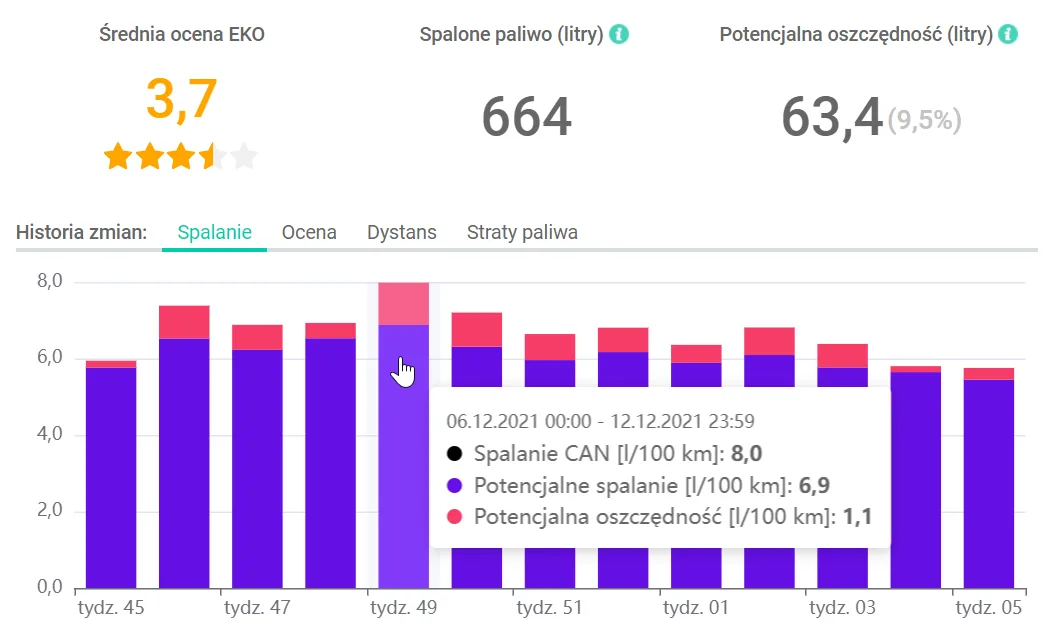
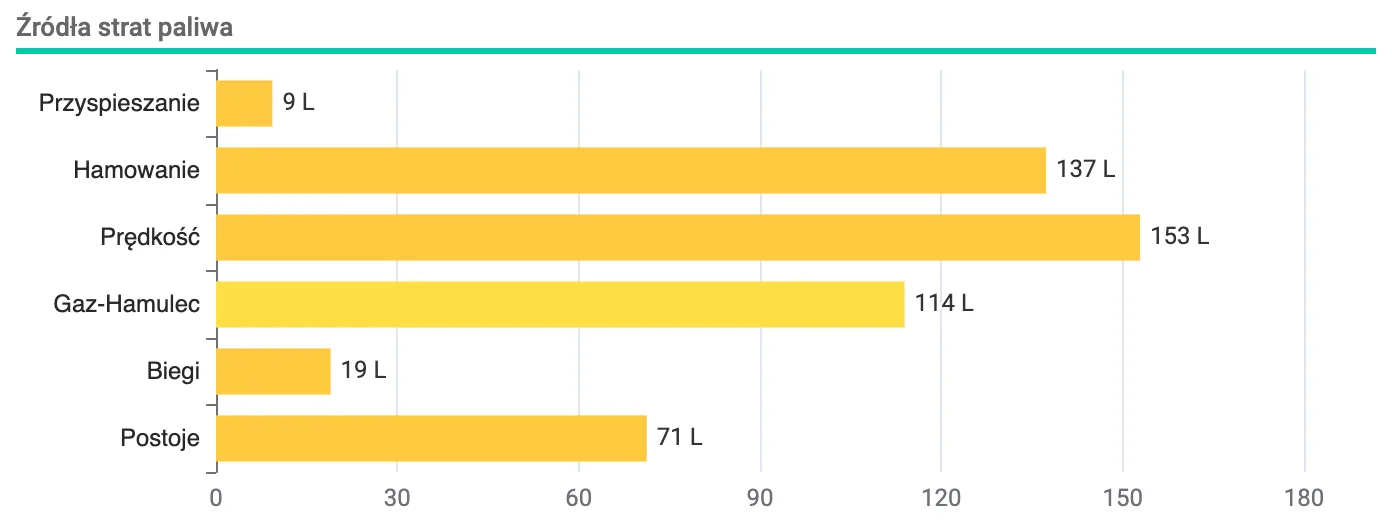
The potential savings chart is just one of the tools that lets the fleet manager control the whole process of reducing fuel consumption. Progress can also be monitored using score and average consumption charts. They visualise how the individual values change over days, weeks and months (for the company's entire fleet or selected drivers). It is worth noting that the charts are closely linked: as the average score of the whole fleet rises, consumption falls. A critical element in reducing fleet fuel consumption is the summary of the main sources of fuel loss, where the user can check which categories of mistakes are the most fuel-hungry in their fleet. The reports above are complemented by rankings of the least economical and least safe drivers.
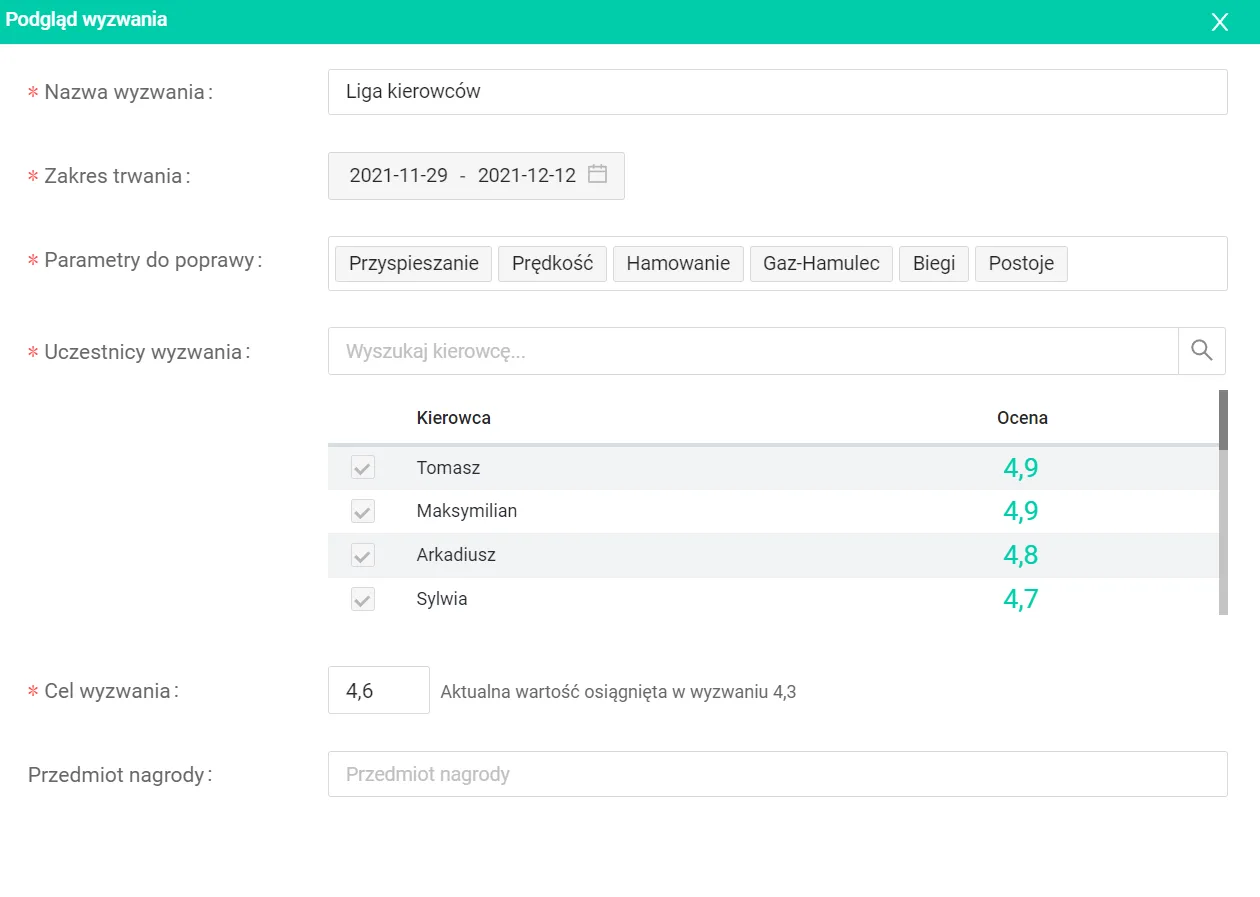
With this knowledge, the fleet manager can create challenges for their employees in the app. They can be configured in any way. For example, we can invite the employees at the top of the uneconomical drivers ranking to take part in a challenge, set the categories in which they make the most mistakes as the scoring criteria, and in this way motivate them to improve their driving style.
Better driving style: longer service life and lower vehicle fleet running costs
One of the headaches for fleet owners and those responsible for fleet management in a company is excessively heavy vehicle use. In extreme cases, brake pads in fleet cars do not even “survive” to 20,000 km. Brake discs and tyres, which should be replaced every 60,000–80,000 km (depending on the manufacturer's recommendations), also usually wear out faster. Both our research and expert opinion confirm that the service life of these components (and consequently the associated costs) is heavily influenced by driving style and how vehicles are used.
The driving style analysis algorithm in the Navifleet app assesses, among other things, the driver's braking and smoothness (inability to anticipate situations on the road). A driver is rated positively if they brake gently (e.g. engine braking), well in advance. Moderate and very hard braking, where the driver noticed the need to slow down too late, is rated negatively.
Improving braking habits translates directly into the service life of brake pads, discs and tyres. This way we can extend it by as much as two times and find the answer to the question of how to optimise costs in the company. At this point it is worth looking at your most recent invoices for replacing these parts and estimating the savings, knowing you would pay them half as often.
A lower fleet claims rate
In 2021 there were more than 22,000 accidents on Polish roads. Excessive speed and misjudging the situation on the road are still cited among the main causes of road incidents. In company fleet management, the driver's life and health obviously come first, but accidents also involve the costs of vehicle repairs, supporting the employee during sick leave and higher insurance premiums due to a higher fleet claims rate.
Our driving style analysis module improves driver safety on the road. How? The suggestions displayed in the Navifleet Driver app help the driver ease off the accelerator at the right moment, plan braking better and accelerate more sensibly. Drivers are not only motivated to correct bad habits behind the wheel but, above all, have a tool that makes it easier. Meanwhile, the fleet manager can identify the least safe drivers in a dedicated ranking and create challenges for them covering the safety-critical categories of mistakes (speed, braking). Remember that along with improved safety, we reduce expenses (including through better insurance rates).
How to lower vehicle fleet costs and vehicle TCO in difficult times
During 2021 the price of fuel (EU 95) rose by around 40%. Price rises did not spare vehicle wear parts either. Driving a private car, we may not feel these changes much, but in fleets the scale effect kicks in, putting serious strain on the company budget. Improving drivers' driving style is one of the most effective ways of reducing fleet running costs in a company. With our technology this process runs more smoothly and its results are measurable. This way we can look at inflation a little more calmly and, despite the unfavourable climate, generate savings and reduce fleet running costs.
From experience we know that most drivers look unfavourably on any attempt to introduce a telematics system into the company. Nevertheless, the process of implementing such a solution does not have to be arduous. Honest communication and openness to employees' needs are the key to a smooth roll-out of telematics for fleet management.
Healthy competition in the fleet motivates drivers to improve their driving style
When developing our driving style analysis technology, we wanted one of its main tasks to be supporting drivers. For this reason we surveyed them to examine their motivations, expectations and preferences regarding such a solution. According to the survey, as many as 93% of them would like to help others (e.g. take part in charity campaigns), and 80% say that competing with others motivates them to change their habits behind the wheel.
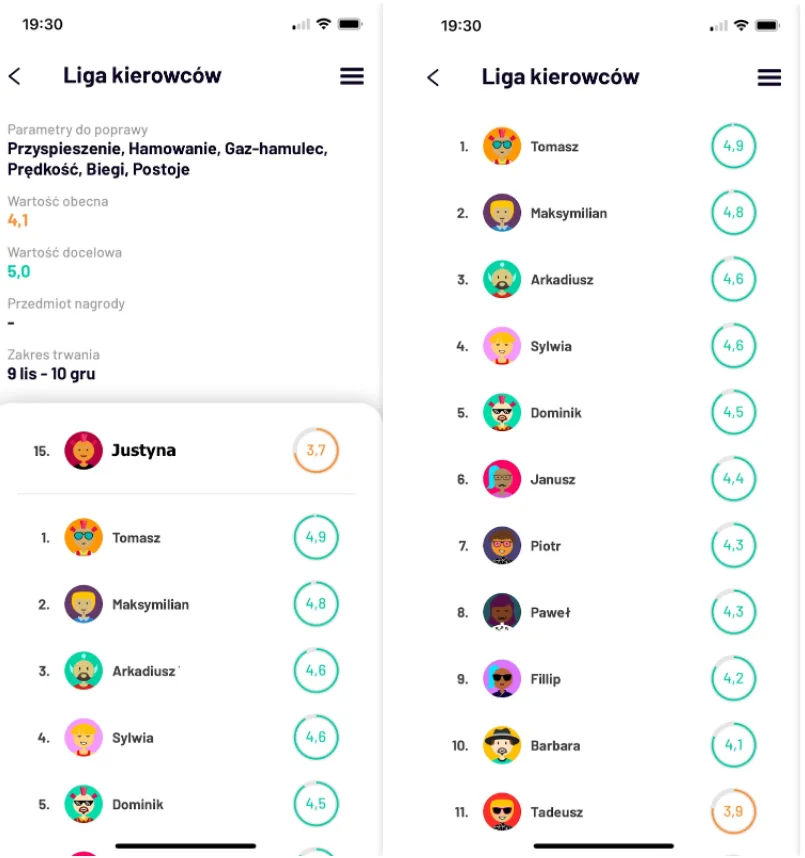
Giving drivers the opportunity to compete with each other on transparent and fair terms can make a smooth telematics roll-out much easier. Competitions in which the winner decides which charity to support can further help overcome drivers' resistance. The challenges module in the Navifleet Driver app is the ideal tool for introducing an element of fun into the fleet. The aim of this module is to motivate drivers to improve their habits behind the wheel. When creating a challenge, the fleet manager decides on its duration, the pool of participants, the goal, the winning rules and the prize. The challenge starts automatically on the date chosen by the fleet manager, and all participants can track their progress against the whole group in the mobile app.
Using telematics as a benefit for the environment
Care for the environment is an equally motivating factor. According to our survey, as many as 87% of drivers care about a clean planet and a “zero-waste” approach. The plan for communicating the intention to roll out telematics to drivers should therefore also include the whole organisation's desire to reduce its carbon footprint. It is worth realising that reduced fuel consumption goes hand in hand with reduced emissions of harmful substances, above all carbon monoxide, nitrogen oxides and sulphur oxides. Economical driving also means less particulate matter (PM10 and PM2.5), which is very harmful to humans.
With our module we can reduce a car's fuel consumption, and therefore the fleet's emissions of harmful substances, by more than ten per cent. The amount of fuel wasted through uneconomical driving is presented in the chart of fuel loss sources and potential savings. These tools clearly show how much fuel consumption would fall if drivers improved their habits, and which behaviours generate the greatest fuel losses. In addition, every driver can track their own consumption and score, which further motivates them to keep striving to improve these parameters. Gradual progress and the awareness of having done something good for the environment is highly motivating for further self-improvement.
According to the “Climate Sentiment Index” report by consultancy Deloitte, 58% of Poles surveyed say they choose products from brands that take action on sustainability. It follows that by reducing emissions we look after not only the environment but also our market position and revenue.
Summary
The overriding goal of a telematics system is to streamline fleet processes and support the fleet manager in daily duties such as reducing fleet running costs. When developing our driving style analysis technology, we combined this with the ability to generate measurable savings that can reach several dozen per cent.

Get in touch with me if you want to start generating savings in your fleet.
Piotr Wójcik
New Business Manager