
Owners of light fleets are increasingly turning to telematics solutions. To a large extent this is a reaction to changes in the market. Recent months have brought fleet managers many challenges they have not had to face before. A sharp rise in fleet running costs, problems with vehicle availability, growing pressure on environmental performance and the need to automate certain processes are all phenomena that have pushed many companies towards telematics. Can such demanding requirements be met without a telematics system? You will find the answer to this question in this article.
Vehicle running costs
Every one of us feels rampant inflation and supply chain problems first-hand. The crisis has also hit companies with vehicle fleets used daily by sales representatives, service technicians and fitters. It is easy to imagine the scale of the rise in running costs for such a fleet when you have to refuel and maintain dozens or hundreds of cars.
Rising fuel prices
Over the past year fuel prices have risen by several dozen per cent. Refuelling a private car, we will probably pay a few dozen zlotys more, but when managing a fleet of several hundred vehicles, the increase in costs can be counted in tens of thousands.
Increasingly, the fleet manager's tasks include cost optimisation, including the costs of fuel consumption. Electrifying a fleet or converting it to gas is an expensive undertaking that is not an investment priority for businesses in times of crisis. Another way to reduce fuel costs has to be found.
Fuel consumption is directly affected by drivers' driving style. So one of the most effective actions we can take is to improve our employees' behaviour behind the wheel. Telematics is an excellent tool for this.
Telematics systems and fuel savings
Technology that assesses the driver's driving style picks up every mistake made while driving and rates journeys in terms of economy and safety. The most fuel-hungry driver behaviours include harsh acceleration and braking, speeding and unnecessary idling with the engine running. Every mistake avoided in these categories can safely be treated as fuel that stayed in the tank.
What is more, the fleet manager has access to data showing how fuel consumption in the fleet is changing and what progress drivers are making in improving their driving style.
From experience we know that implementing telematics for fleet management can reduce fuel costs by more than ten per cent. You can read more about our pilot implementations of driving style analysis technology HERE and HERE.
The cost of wear parts
Supply chain disruptions caused by the pandemic and the war in Ukraine have affected the automotive industry and the price and availability of components. This is another problem for light fleet managers, who have to reckon with higher costs for replacing wear parts such as brake pads and discs.
Here too, telematics and the solution described above come to the rescue. Harsh and clumsy braking affects the wear of brake pads and discs. By eliminating such behaviour, we can extend the life of these components by as much as two times.
Insurance costs
In the first quarter of 2022, average insurance premiums worldwide rose by 11 per cent. This is another cost increase that light fleet managers have to contend with (inflation does not spare the transport industry either).
Telematics solutions in a fleet also mean greater employee safety and a lower vehicle claims rate. As a result, we gain a better position in negotiations with the insurer. Fleet insurance is often structured to treat companies with telematics more favourably. Being able to negotiate more attractive rates is a big saving for a business, especially when we are talking about a fleet of dozens or hundreds of vehicles.
Environmental trends
Recent years have brought an ever stronger emphasis on environmental protection and broadly understood sustainability. Environmental responsibility is slowly evolving from a trend into a permanent element of company policy in many industries. This transformation touches various areas of activity, including vehicle fleet management. The term “green fleet” is associated mainly with hybrid and electric vehicles. Replacing the entire fleet with such vehicles, whose environmental credentials are increasingly questioned, does not have to be the only solution.
Telematics and emissions reduction
Emissions of harmful substances into the atmosphere can be reduced with telematics systems for fleet management. In this case the environmental benefits are indisputable.
Thanks to driving style monitoring technology, we receive reliable, specific information about the amount of fuel used and, above all, we can genuinely reduce consumption. A telematics system for a light fleet fits the definition of sustainable development perfectly. It brings benefits on many levels (finance, safety, process automation) while looking after the environment.
Telematics systems have one more important feature. It can safely be said that in this case environmental protection pays for itself. The savings from reduced fuel consumption fully cover the subscription costs and feed the company budget.
The image of an environmentally responsible company
According to the “Climate Sentiment Index” report by consultancy Deloitte, 58% of Poles surveyed say they choose products from brands that take action on sustainability. This means that an initiative to reduce fuel consumption can indirectly affect sales of our products or services.
Vehicle availability
Problems with the availability of certain components in the automotive industry have resulted not only in higher prices for parts for the end customer. Currently, the biggest problem for fleet managers is the almost zero availability of vehicles. In the post-pandemic reality, we have to wait from a few months to over a year for a car from the moment the order is placed.
Allocating vehicles with a telematics system
Since the fleet manager has to ensure the availability of mobile resources for employees, this situation is a real challenge for them. Despite the unfavourable climate, many companies are growing and expanding their workforce (e.g. sales reps or service technicians), who also need cars as tools for their work. In conditions of limited vehicle availability, greater emphasis is placed on better vehicle allocation and moving vehicles from users who mainly need them for private purposes to users for whom the car is a basic work tool.
Private and business journeys and GPS tracking
Allocating vehicles among employees is a thankless and difficult task for the fleet manager. Managing a fleet in the face of a crisis is a problem that can only be solved on the basis of reliable data.
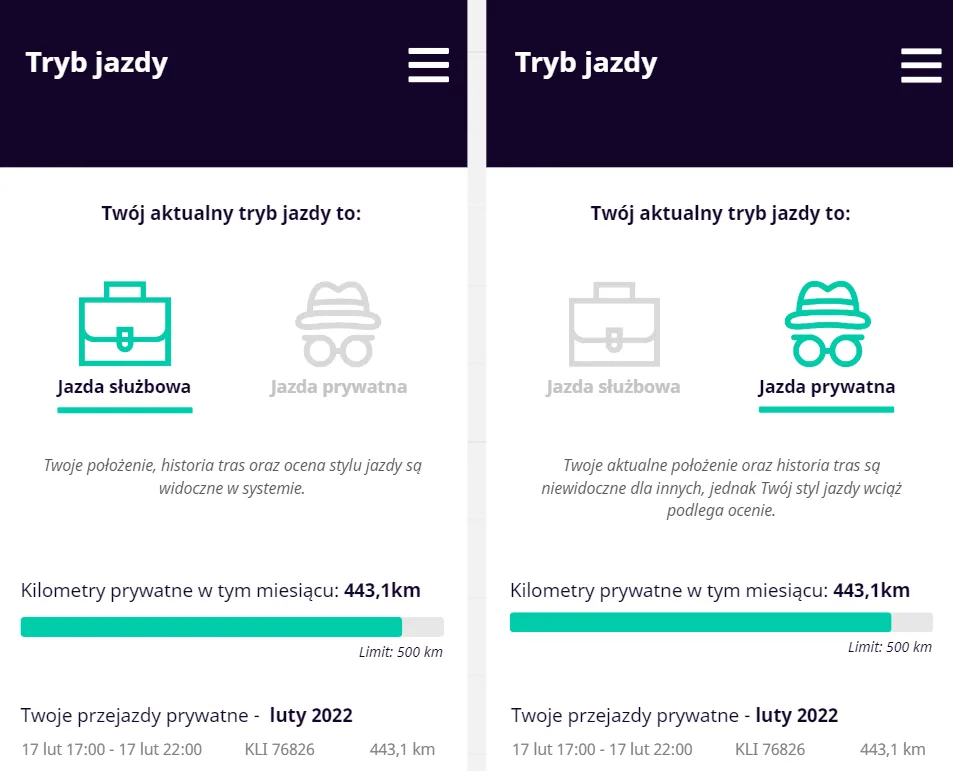
Telematics provides such information. This primarily means analysis of drivers' working time and of kilometres driven for business and private purposes. It is not only real-time GPS tracking but, above all, the ability to generate business/private mileage reports for a given period.
These reports make it possible to determine how vehicles are used and for what purpose an employee uses a given car. Based on such data, the fleet manager can decide to reassign a vehicle to another employee. Presenting reliable, specific information not only optimises the use of mobile resources in the fleet but is also a solid argument in the event of objections from drivers. Numbers and measurable values should always be the basis of communication between the fleet manager and employees.
Automation of processes and information flow
The fourth industrial revolution has brought a wealth of possibilities and solutions for every industry. Technological progress makes it possible to increase productivity and optimise processes to levels that were unattainable until recently. The wide availability of innovative solutions means that companies that do not adapt to the market and automate their work simply fall behind. Innovation has become essential for healthy, fair competition with growing rivals.
From real-time GPS tracking to fuel control
Telematics is the answer to the contemporary problems and needs of companies that manage fleets. Telematics systems offer many possibilities. It starts with such basic features as real-time GPS tracking of the vehicle. Telematics solutions also provide a range of data on fuel consumption, drivers' working time and vehicle operating parameters. Telematics data can also be used to settle mileage allowances, taking into account the distance covered during work and privately.
What is more, in many cases the telematics service can be integrated with the e-TOLL system (many GPS devices used in telematics can support the payment system introduced last year).
Let's not forget that telematics systems also include such advanced solutions as driving style analysis technology, which not only helps reduce fuel consumption in the fleet but also affects employee safety and environmental protection.
Taking the load off the fleet manager
A telematics system is first and foremost a work tool for the fleet manager. The scope of duties in this position is now so broad that telematics may be the only way for a mobility specialist to use their working time effectively.
Besides tracking cars, solutions of this type make it possible to streamline fleet management on the administrative side. Through telematics devices, the application collects information about every vehicle and the dates of inspections, insurance and oil changes. The fleet manager does not have to remember upcoming deadlines or keep records of such data in Excel. The application reminds them itself.
Benefits for the whole business
The fleet manager is not the only one in the business who benefits from an advanced telematics application. The system is also useful for other departments. This includes accounting, which telematics helps to settle business trips efficiently.
Sales directors and managers, as well as the HR department, can also use solutions of this type. A modern telematics system allows integration with other applications dedicated to other areas of the business.
The tasks of telematics systems include supporting individual units within the business and aiding the flow of information between them (saving a great deal of time and work).
Telematics for hard times: an expert's view
Is telematics already a necessity that every fleet manager has to face? We asked Navifleet's development manager for his view.
Fleet management is a constant balancing act between a well-fed wolf and a sheep that survives. On the one hand, every fleet manager's goal is to provide colleagues and the board with maximum mobility; on the other, the cost of that mobility must be kept as low as possible. Looking for savings in a fleet is like operating on a living organism. Not everything we would like to do is possible, and what we can do does not always bring spectacular results.
Telematics is no longer GPS tracking; you could say that GPS tracking is an option within telematics. Telematics today alerts the fleet manager itself to detected deviations from the norm, analyses drivers' driving style, teaches the right behaviour and automatically monitors employees' compliance with the fleet policy. And all this is possible without tracking employees. So, to answer the question in the title: telematics is an option for everyone, but a necessity for the best. says Piotr Smoleń, development manager at Navifleet.



