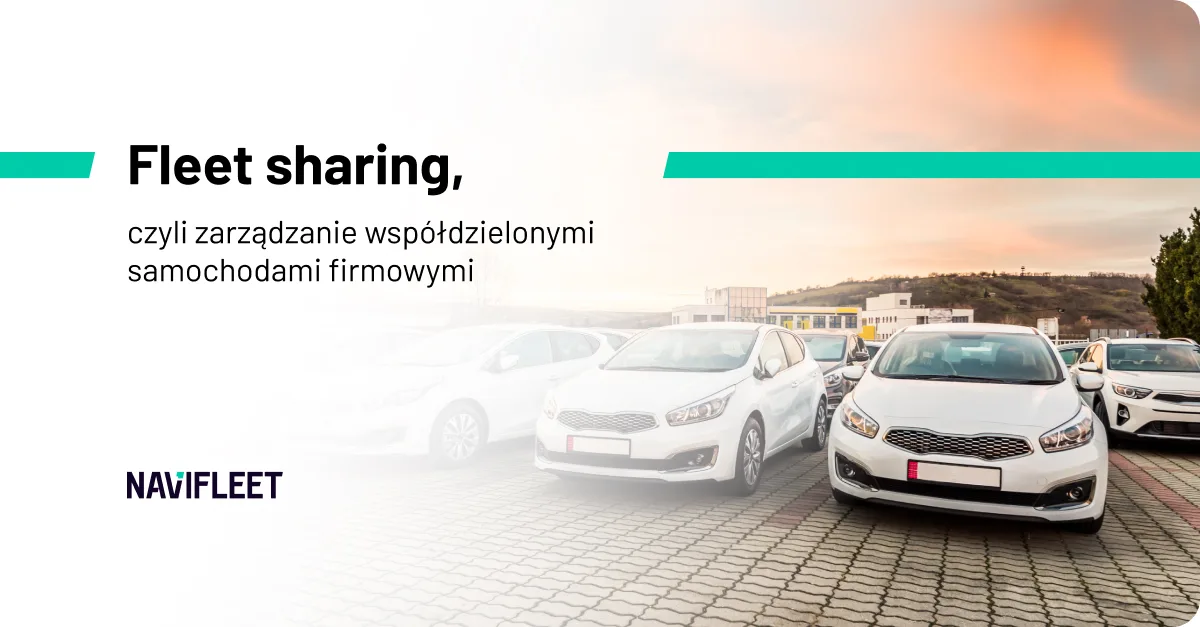
Car sharing keeps growing in popularity. It is an economical solution, but one that comes with many challenges for those managing the fleet. In today's article we explain why fleet sharing is a cost-effective option and what to look out for when introducing it in your company.
When are we dealing with shared cars?
Shared cars are (as the name suggests) cars used by several drivers. Most often, cars of this type are made available through so-called car sharing or fleet sharing. In the first case, the fleet owner lets others use its vehicles for a fee. Fleet sharing, on the other hand, means sharing company cars.
The car sharing model is becoming increasingly popular. (This is evidenced, for example, by the growing popularity of urban "cars by the minute" such as Panek Carsharing, Traficar and 4mobility.) It is a solution used ever more readily, above all because it minimises the cost of owning and maintaining cars.
Sharing vehicles is an excellent idea. It means fewer vehicles are needed to provide mobility for everyone who needs it. This reduces costs and is a greener solution. It allows resources to be optimised: with sharing, a large part of the fleet sits unused in the car park less often. This model often makes it possible to reduce the size of the fleet without compromising its mobility.
What are the weak points of shared car management processes?
Car sharing can bring great benefits – but it can be problematic to manage. Managers of shared vehicle fleets still face numerous challenges. Car and fleet sharing are relatively new ideas that society is only just learning. That not everyone has grown into this tool is evidenced by the numerous press reports of incidents reported by users of vehicle sharing systems. Examples include torn-off fuel filler caps, city bikes with punctured tyres or ripped-off saddles, and an electric BMW i3 parked by the railway tracks in Warsaw.
A lack of common sense and a sense of impunity among users are the biggest challenges for fleet operators. A second barrier to implementing a shared vehicle system may be the fear of the difficulty of introducing a new culture in the company. Having taken part in introducing a fleet sharing culture at Navifleet, I am aware of the legal and technological challenges that come with introducing fleet sharing rules in a company. After all, you have to regulate the scope of responsibility, key handover and return procedures, self-inspection procedures and the required maintenance, or compliance with insurance and roadworthiness test deadlines. Who is supposed to do this? How are they even supposed to know they have to do it? How do you protect the fleet against unauthorised use and circumvention of security systems? These and many other questions come to mind for anyone who tries to think about introducing a car sharing culture in their own company. A conscious approach and considering certain issues early enough, however, mean that introducing a new culture into the business is not as difficult as it might seem.
How can technology be used to optimise the management of shared cars?
Telematics is still associated primarily with retrieving data from the vehicle: e.g. checking the odometer, accelerator pedal pressure or constantly measuring the fuel level. Modern technology, however, offers far greater possibilities for vehicle control – this one-way "communication" can be turned into a lively "discussion" of commands and responses between vehicle and server.
One area of telematics that is still not widely used is remote control of assets, for example via a mobile app. This makes it possible, among other things, to remotely lock or unlock the vehicle's central locking or close the electric windows. These are of course very basic features – but we can build further elements onto them to protect the fleet against unauthorised use or accidental user error. This increases security and protects the vehicle from damage. For example, with the app we can allow the central locking to be engaged only when all the doors and the boot are closed, the ignition is off and the keys have been put in the designated place in the vehicle.
Options that go further can also be used. There are features that provide additional protection for the car – for example, it is possible to define a zone in which the vehicle must be located before it can be remotely unlocked and locked.
Are such solutions very expensive? Not necessarily. Sometimes a device costing a few hundred PLN and a free app are enough.
What do you need to take care of to implement fleet sharing successfully in your company?
The technological barrier, although secondary, cannot be underestimated. Implementing a fleet sharing management system in a company quickly and at low cost can be very difficult. Implementation takes place in stages, and during the individual phases particular attention must be paid to several important matters.
Firstly, the process of remotely unlocking and locking the central locking is very important. It will be autonomous and must always work reliably. 99% effectiveness is not enough – in that case, in a fleet of a hundred vehicles, the system operator would regularly have to intervene. This would significantly reduce the return on the investment. Of course, there are many ways to ensure high availability and reliability, e.g. diversifying the technologies of the communication channels between the server and the vehicle, alerts about poor mobile network coverage, and asynchronous generation of data from the device, e.g. after a change in the state of the central locking or a door being opened.
The second pillar is security, i.e. the system's resistance to interference by third parties aimed at deceiving the system and damaging or stealing the vehicle. To raise the level of security, the system should know the state of the vehicle perfectly – the central locking, doors and boot. It must also be able to check whether the keys have been put in the designated place, which driver has authenticated in the vehicle, where the vehicle is and whether it remains within mobile network coverage. This information should be streamed to the system. Decision processes are carried out on its basis, which may or may not allow an action to be performed. This is intended not only to protect the vehicle but also to increase user safety. In addition, such features make it possible to ensure that only an authorised user gets into a given vehicle. (That is: they can only unlock and lock the vehicles they have permission to use – authorisation from the central vehicle booking system or a longer-term assignment by the administrator.) The mobile app used to control the state of the vehicle's central locking must also provide a form of two-step authentication (e.g. an app login and password plus unlocking the phone again with a fingerprint or an on-screen pattern).
What will you gain by implementing fleet sharing consciously in your company?
There are many benefits of implementing fleet sharing wisely in a company, but it is worth starting from the question – when should the decision be made to introduce a vehicle sharing culture in the company. At the outset it is a good idea to analyse fleet utilisation. Such a bird's-eye view will show fleet utilisation over time, and it may turn out that a large part of it never leaves the car park. This is a good moment to review the need for every employee to have a "private" company vehicle.
Where employees can use shared vehicles and do not have them exclusively, recurring problems with an unclear scope of responsibility may be a reason to consider introducing fleet sharing procedures. If, yet again, the car is dirty and not vacuumed because nobody thought to take care of it, or its technical condition is deplorable because nobody thought it needed to go to the mechanic, these are the first symptoms indicating that the company's procedures need improving.
The greatest benefit of fleet sharing is the cost reduction that comes from eliminating vehicles that are maintained but not used. We save on leasing instalments, oil changes, servicing, insurance and all the periodic costs incurred regardless of how much the vehicle is used. In addition, there is the automation of looking after the vehicle's technical and visual condition. Drivers must respond when required to a servicing requirement or a scheduled, recurring visit to the car wash. Every operation must be confirmed with a photo or a comment from its author, which makes it easier for everyone to look after the common good.