A professional safety audit of a company car fleet answers a real need among businesses that operate a group of company vehicles. Why? At some point, many companies running vehicle fleets arrive at the decision to reduce the number of collisions and claims in their fleet. The reasons behind that step vary: it may be a wish to cut operating costs, a serious accident involving one of the employees, negotiations of a new policy with the insurer, a desire to do more in the area of CSR, or other matters.
Whatever the reason, at the moment of taking that decision a company often knows neither how safe its fleet currently is nor what it could do to improve. In that situation it is worth commissioning a fleet safety audit.
What is a fleet safety audit and how can a fleet manager use it?
A fleet safety audit is a comprehensive assessment of the state of safety in a vehicle fleet. The company that commissions it gains the following benefits:
- information on how far the current state deviates from the desired state in those areas of its operations that are correlated with the claims rate in its fleet
- an assessment of which aspects of its operations need correcting in order to bring that claims rate down
- guidance on what actions to take to improve the level of safety in its fleet.
In theory, any company can audit the safety of its own fleet, but for reasons we discuss later in this article it is better to have an external provider do it. Bear in mind, however, that for the auditor to do a good job in our company, our active cooperation as the recipient of the service is essential.
The substantive scope of the audit should always be similar, but the form in which it is carried out can differ. Depending on the client's specifics and needs, the audit can also be a more or less formalised process.
- Where the client is a large company that plans to be audited at set intervals, it makes sense to run the audit in a standardised form, with a numerical score for each area analysed and documentation of the steps taken.
- By contrast, in a small business being audited for the first time, the audit may take a more consultative form.
Before the audit begins, it is best to agree with the provider on a format that strikes a balance between the effort both sides put in (and therefore the cost) and the benefits that can be achieved. The audit provider should also take into account the specifics of the company being assessed, adapting the scope and type of recommendations to the recipient's needs. For example, a business running 10 cars usually does not need procedures regulating every aspect of its fleet or a long-term safety strategy. At the same time, such procedures and a strategy may well matter for a listed company with a fleet of several hundred cars, or for a company whose core business is operating vehicles (such as a courier or forwarding firm).
The audit versus other actions aimed at improving fleet safety
We now know what a fleet safety audit is. Importantly, it is only one of a whole range of actions that can serve to improve safety in a fleet. It is, however, one of the first worth taking (right after we have secured the board's backing for our efforts). Thanks to the audit we will be able to plan all our subsequent fleet safety activities more accurately.
A fleet safety audit: which areas should it cover?
A well-conducted audit should cover every area of the company's operations that may have a bearing on fleet safety. There are more of these than might appear at first sight, because driving safety is a more complex matter than we tend to think day to day. In the version presented in this article, the fleet safety audit covers 12 areas of the company's operations, made up of a total of 40 sub-areas. Depending on the audit provider, the split into areas and sub-areas may differ, but it should always cover every issue that directly or indirectly affects the claims rate.
During the audit, each area and sub-area is analysed by comparing the current situation in the company being assessed with a theoretical ideal state that it should aim for.
The scope of issues a fleet safety audit should cover is presented in the table. In the rest of the article we go through, in turn, what to look at in each area and sub-area during the audit.
Scope of a fleet safety audit

Area 1: determining the current level of fleet safety
Sub-area 1. Determining the current level of fleet safety
Where should a fleet audit focused on safety begin? The starting point should be to determine the current claims rate in the company under review and compare it with data from companies with a similar profile. This does not tell the whole story, but it gives an initial picture of where we stand as a company in terms of fleet safety and allows us to track our progress later.
Basic fleet safety indicators may include, for example:
- the number and cost of accidents, collisions and car-park damage per 1 million kilometres driven by the vehicles per year,
- the number and cost of accidents, collisions and car-park damage per vehicle,
- the number and cost of accidents, collisions and car-park damage per user.
Proper fleet control matters a great deal in the context of the challenge of managing fleet risk effectively in a business. If the company has not previously collected accident and collision statistics, gathering the data may prove fairly time-consuming. Some of the necessary information, in particular comparative data from companies similar to ours, can usually be obtained from the insurer covering our vehicles.
Area 2: Fleet Safety Policy
Sub-area 2. Fleet Safety Policy
The second area to be analysed during the audit concerns the so-called Fleet Safety Policy. A Fleet Safety Policy is a set of rules governing how company vehicles are used in the areas that affect safety.
The first thing checked here during the audit is whether a Fleet Safety Policy exists in the company at all, and the second is what form it takes. The optimal state is one where the Policy exists as a document signed by a member of the board. The written form and the endorsement of company management give the Policy the right weight and make it possible to later enforce specific behaviours among employees.
The Fleet Safety Policy may be a separate document or form part of the Fleet Policy (or its equivalent under another name, such as Car Policy, company vehicle usage rules and so on). The audit also checks its content. It should set out in detail such matters as:
- rules for the safe use of vehicles (e.g. the obligation to wear seat belts, safe carriage of luggage or cargo, use of the phone while driving),
- the safe driving rules in force in the company (see sub-area 37),
- criteria for selecting fleet vehicles in terms of active and passive safety,
- rules for using the GPS tracking installed in the vehicles (if the company uses such a solution),
- rules for analysing statistical data on the company's claims rate,
- a list of the people responsible for fleet safety in the company and their duties.
The audit verifies whether rules and guidelines of this kind exist in the Policy, as well as their form and level of detail. Where gaps or shortcomings are found, the provider carrying out the fleet safety audit should propose how to fill them.
Area 3: board commitment and fleet safety management
Sub-area 3. Formal accountability of the board and managers
The audit checks whether the board and all lower levels of the management hierarchy have formal, documented accountability and KPIs to achieve in relation to fleet safety.
Fleet safety indicators should be one of the formal criteria for evaluating managers' performance. Such tangible, concretely defined targets are usually necessary for safety standards to be treated as something that matters and to actually be observed. Conversely, a lack of formal accountability and financial consequences usually means that safe driving rules remain, to a large extent, a list of good intentions.
Sub-area 4. Fleet safety budget
The next matter verified during the audit is whether fleet safety has a separate, dedicated budget in the company. That budget should also be sufficient to deliver the fleet safety objectives the company has set itself. Excessive savings in this area can reduce the effectiveness of the actions taken and prevent them from delivering the intended results.
Sub-area 5. Organisation of work in the company
A fleet safety audit makes it possible to identify areas and sub-areas with deficits that affect, for instance, the claims rate. One such sub-area may turn out to be the way work is organised in the business.
The auditor should also check whether there is a conflict in the company between the targets set for employees and their compliance with safe driving rules. If employees have to drive at dangerous speeds or break other safety rules in order to meet the targets imposed on them, this is a situation that, over the long run, breeds accidents. An example of such a dangerous conflict of goals might be a bus company whose timetable is constructed in such a way that drivers are forced to break speed limits to keep to the scheduled journey times.
This is a difficult issue to analyse and requires goodwill and willingness to cooperate on the part of the audited company's board. Bending safety rules to raise fleet productivity and achieve the best possible result is as common as it is potentially sensitive and hard to combat in any profit-driven organisation. In practice the auditor is often forced to limit themselves to general recommendations here, because they cannot obtain reliable information from the company about the real state of affairs.
Sub-area 6. Active oversight by the board
As we mentioned, companies are profit-driven organisations, so there will always be a natural tendency within them to bend safety rules in the name of optimising operations, raising efficiency and maximising the financial result. In practice, the only body able to make sure that does not happen is the company's board. That is one of the reasons why active and continuous board oversight of compliance with safe driving rules in the fleet is essential. A fleet safety audit allows us to assess whether such oversight actually takes place and how it manifests itself.
Sub-area 7. Dedicated human resources
A fleet safety improvement project, like any project, cannot do without people to deliver it. The audit therefore checks what human resources the company has assigned to fleet safety tasks: how many people are involved in the matter and at what level of the organisation they sit.
The minimum variant is a situation in which there is a dedicated person in the company whose formal job duties include looking after fleet safety. Meanwhile, in companies that lead the way in road safety there are often working groups of several to a dozen or so people whose job is to keep the claims rate low (see Sub-area 9).
Sub-area 8. Safety improvement strategy
A fleet safety audit also aims to verify whether the company has a long-term strategy for improving and maintaining fleet safety. Such a strategy should be set out in writing and approved by the board. It should define long-term goals, a plan for achieving them, budget assumptions, an assessment of the available actions in terms of cost and effect, risk areas, and the people and departments responsible for delivering each action.
Writing up a formal strategy will not be sensible in every company, however. The auditor should be able to recommend the optimal solution to the audit's recipient.
Area 4: internal communication on fleet safety
Sub-area 9. Fleet safety working group
As mentioned above, it is good practice for the company to designate a specific person or group of people whose job is to oversee fleet safety and plan related actions. The group may vary in composition and size depending on the scale and profile of the company. In a large organisation it may include, for example, the fleet manager, a dedicated board member, employee representatives, the head of administration, representatives of HR and health and safety, and often also the sales director (because most company vehicle users usually report to them). Among other things, this committee analyses claims data, jointly reviews accidents and collisions, and on that basis formulates proposals for future improvements.
The specialist carrying out the fleet safety audit checks whether such a working group exists in the company (or, in a smaller organisation, a dedicated person), what its operating rules and prerogatives are, and the actual history of actions it has taken.
Sub-area 10. Company-to-employee communication
The audit also verifies whether the company actively communicates with employees on matters relating to the fleet and its safety, and what forms that communication takes. This matters a great deal if we care about managing fleet risk effectively. Two forms of communication in particular can be expected in optimal circumstances:
- The company distributing up-to-date information about the state of fleet safety among employees. This is important partly because it involves employees in safety matters and demonstrates the company's commitment to the subject.
- Educational activities: sending staff newsletters, advice, handbooks, safe driving tips and so on.
Sub-area 11. Employee-to-company communication
A comprehensive fleet safety audit should also check whether communication between the company and employees works in the other direction too, i.e. whether drivers of company vehicles also have a say in matters relating to driving safety. The ideal situation is one in which the company collects employees' suggestions on fleet safety and takes them into account in planning its actions as an advisory voice.
This matters because the active involvement of employees in a project aimed at improving fleet safety is one of the foundations of a so-called safety culture.
Sub-area 12. Regular meetings with drivers
Another communication-related matter assessed during the audit is whether the company holds regular meetings with employees on driving safety topics. The point is for managers and employees to have a forum where they can communicate on safety matters. Such meetings might, for example, cover changes in traffic law, present an analysis of recent collisions and accidents in the fleet or the current gamification results from the telematics application, or host workshops on driving-related topics. The audit's task here is to verify whether such meetings take place, as well as their frequency and form.
Area 5: investigating accidents and collisions
Sub-area 13. Analysis of accidents in the fleet
Effective fleet control, and the systematic collection and analysis of accident data that goes with it, are very important from the point of view of looking after fleet safety. In the context of this sub-area it should be mentioned that the auditor checks whether all accidents and collisions that occur in the fleet are properly documented by the company and whether, in every case, an attempt is made to understand their causes. The auditor also assesses the format of the data collected, how and where it is stored, and how accident reports are distributed within the company.
Collecting and analysing accident data allows a statistical view of the claims problem in our fleet and lets us find recurring causes of such events. Identifying the causes, in turn, makes it possible to plan remedial actions that will help prevent similar events in the future.
Sub-area 14. Drawing conclusions from accident investigations
A safety audit should also check whether practical conclusions are always drawn from the above accident investigations and whether preventive actions for the future are proposed, together with a timetable for implementing them.
Sub-area 15. Putting the conclusions from accident investigations into practice
The audit should also verify whether the preventive actions planned as a result of analysing accident events are actually implemented in the company.
Area 6: analysis of fleet safety data
Sub-area 16. Fleet claims database
The company should have an application (a database) in which statistical data on the state of fleet safety is collected. During the audit it is verified whether:
- the company has an IT solution for collecting this kind of data,
- that application is actually populated with data, and how often,
- what data is collected and whether its format allows analysis,
- how often the collected data is analysed and interpreted.
Sub-area 17. Fleet safety indicators
The list of claims data collected in the company should be set out in writing in the Fleet Safety Policy or the Fleet Policy. The data that should be collected includes, for example, the number and cost of accidents, collisions and car-park damage, the number of vehicles and the mileage they cover. Ideally, the company should also keep its fleet under control by monitoring so-called proactive indicators: the number of people who have completed a safe driving course, the number of vehicles with GPS tracking installed, the number of people who have attended first aid training, and so on. A fleet safety audit allows all these matters to be analysed in detail.
Sub-area 18. Conclusions from the fleet claims analysis
A fleet safety audit also includes an assessment of whether practical conclusions are drawn from the analysis of the data collected. There should be a mechanism of continuous improvement in fleet safety in the company, based among other things on the conclusions drawn from the claims statistics gathered.
Sub-area 19. Benchmarking the fleet's claims rate
A fleet safety audit should also verify whether the company compares its fleet safety indicators against industry, national and other benchmarks. A company often finds it hard to judge on its own whether the scale of claims it sees in its fleet is cause for concern. Comparing ourselves with the results achieved by companies similar to ours will give us a better idea of where we stand on safety. Comparative data can be sought, for example, from the insurer, from our company's branches in other countries (if we are part of an international corporation), or from some of the providers of fleet management software.
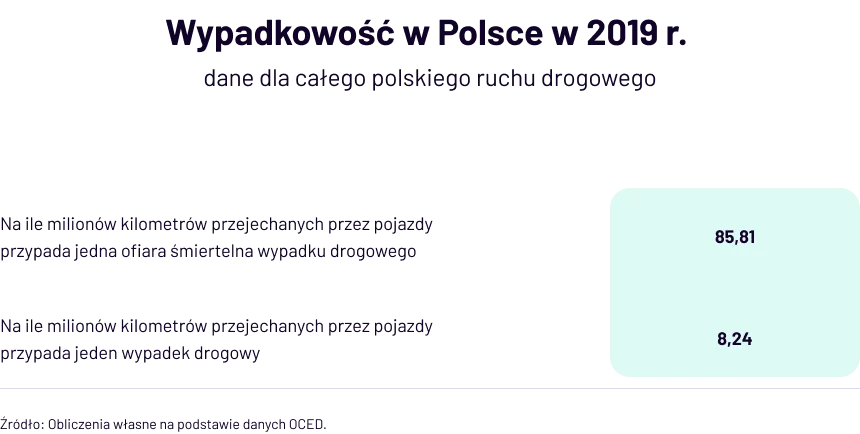
National road safety data can also serve as a basic benchmark. For example, the data for 2019 (the most recent available) for Poland looks as follows:
Area 7: technical solutions
Sub-area 20. Fleet telematics
The next area assessed during a fleet safety audit is any additional technical solutions the company has installed in its vehicles to reduce the risk of accidents. The most important solution of this kind is telematics (GPS tracking) with a function that scores drivers' driving style for safety and fuel economy. The audit assesses:
- whether the company uses telematics at all,
- what functionality the solution in use offers,
- whether the data collected through telematics is actually used to motivate and discipline drivers, and if so, how.
Sub-area 21. Other solutions
The audit also checks whether the company being assessed has installed other technical solutions in its vehicles to improve driving safety. The most common are alcohol interlocks and cameras monitoring the road situation and/or the driver's behaviour.
Area 8: driving style analysis
Sub-area 22. Reward and penalty system for drivers
Both good and bad driving by an employee should be noticed by the employer. On the one hand, the company should publicly recognise safe and economical driving among its employees, and on the other, discipline those who drive contrary to these rules. The safety audit therefore checks whether the company has a system of rewards and penalties to motivate employees towards the desired behaviour behind the wheel, and what it looks like. One of the most widely used and most effective motivational tools in this area is gamification based on data from the telematics application (provided, of course, that the company uses telematics).
Sub-area 23. Feedback from managers
The second matter the auditor verifies in the area of driving style is whether employees receive feedback from their managers about their driving. Ideally, such feedback should form a formal part of the employee appraisal system (annual or quarterly reviews, etc.). Managers raising the subject helps enforce the desired behaviour among drivers. It also reinforces the sense that driving safety is something that matters to the company, and so helps build a so-called safety culture, which is important, among other things, in the context of managing fleet risk in the business.
Area 9: driver recruitment
Sub-area 24. Driver history
When carrying out a fleet safety audit, one should check whether driving safety is taken into account when recruiting employees for positions that involve driving. In a company that cares about fleet safety, verifying a candidate's history as a driver should be part of the recruitment process. The information obtained should cover, for example, the number and type of collisions the person has been involved in, their driving experience, their penalty points record and the licences they hold. This makes it possible to screen out some candidates who do not meet the requirements at the recruitment stage and demonstrates the emphasis the company places on driving safety.
Sub-area 25. Licence verification
The audit also checks whether the company, before handing over a company vehicle (or before hiring a person), verifies that the driver meets the legal requirements for driving the given type of vehicle. It also checks whether such verification is repeated later, and how often. This concerns, for instance, holding a driving licence of the relevant category, holding an ADR certificate, or wearing any corrective lenses noted on the driving licence. Operating in compliance with applicable regulations is a must for any company that wants to look after fleet safety.
Sub-area 26. Test drive
When recruiting for positions that require frequent driving of a company car, companies can also verify candidates' skills through test drives. The audit checks whether such drives are carried out and in what form.
Sub-area 27. Induction safe driving training for new employees
A fleet safety audit also has the task of assessing whether the company has an induction training programme for new users of company vehicles and what it contains.
Area 10: training and education of company vehicle users
Sub-area 28. Safe driving training: analysis of the fleet's needs
The provider carrying out the fleet safety audit checks:
- whether the company regularly (at least annually) analyses employees' training and educational needs in the field of safe driving,
- whether, when planning the training programme, it takes into account the issues previously identified in the company as causes of accidents and collisions.
Sub-area 29. Safe driving training and driver education: delivery
The audit should also verify whether the training and educational activities are actually delivered, what their programme is and what proportion of employees they cover.
First, the company should have a safe driving training programme for employees. Large, comprehensive training sessions should be held no less often than once every three years.
Second, the training and education programme should be varied, so as to reach as many people as possible. Educational activities should also be as frequent as possible so that employees' knowledge and skills do not fade.
Third, ideally all users of company vehicles should have access to training.
Sub-area 30. Defensive driving
According to the latest knowledge, driver training and education should focus above all on so-called defensive driving. Defensive driving is a set of techniques aimed at anticipating and preventing dangerous road situations. It includes proper observation of the road, keeping a sufficiently large gap to the vehicle in front, conscious choice of speed, compliance with the rules and other matters. The audit assesses whether the training delivered is actually based on these principles.
Sub-area 31. Economical driving
Many people assume that practising economical driving (eco-driving) only makes sense as a way of cutting the cost of fuel used on the road. Observation of real life shows, however, that in companies that have managed to persuade employees to apply eco-driving principles, the claims rate falls as well. That is why the audit checks whether the company runs educational activities among employees aimed at instilling eco-driving principles. Today these activities are most often delivered as educational messages sent through the telematics application. It is also possible, however, to organise dedicated theoretical and practical eco-driving training.
Sub-area 32. Evaluation of safe driving training
The last matter in this area verified during the audit is whether the company evaluates the educational activities it runs. The employer should assess each time whether the investment in training paid off, and on that basis decide whether to continue such activities in the future, optimise them by introducing appropriate modifications, or drop them.
Area 11: safe vehicles
Driving safety does not depend solely on driver behaviour. Suitably safe vehicles also have a role to play. This matter is therefore also assessed by the specialist carrying out the fleet safety audit.
Sub-area 33. Vehicle safety: guidelines
First, the audit assesses whether the company's Fleet Safety Policy (or an equivalent document) contains written safety-related criteria for selecting vehicles for the company fleet. An example of such a requirement might be a condition that every vehicle be equipped with a specified number of airbags or hold a given number of stars in Euro NCAP tests.
Sub-area 34. Consultation with employees
Second (in the area of safe vehicles), the auditor assesses whether the company consults employees on the choice of fleet vehicles in the context of their safety. Ideally, the employer should collect such suggestions from employees both before purchasing vehicles and during their use. Employees use the vehicles every day and can give the employer information about their day-to-day operation that would otherwise be unavailable. Of course, this does not mean the employer has to act on every suggestion.
Sub-area 35. Monitoring the technical condition of vehicles
A fleet safety audit should also include verifying whether the company has a schedule of regular technical condition checks for its vehicles, and whether it is followed in practice. In some cases warranty services and mandatory roadworthiness tests may prove insufficient.
Sub-area 36. Vehicle inspections
The last vehicle safety matter verified during the audit is whether the company has required employees to carry out their own inspections of the condition of the vehicles they use. They should also report the results of these inspections regularly. The inspections should cover easy-to-verify but important matters such as the condition of the lights and tyres. Regularity here makes it possible to identify and flag the need for minor repairs or servicing on an ongoing basis, which in the longer term has a positive effect on fleet safety.
Area 12: rules for using company vehicles and other matters
Sub-area 37. Safe driving rules
A fleet safety audit should also check whether the Fleet Safety Policy contains a set of safe driving rules that the company requires employees to follow. Such written rules, even if most drivers ignore them, define what the norm is in the company and make it possible to enforce specific behaviours. Setting these rules out in writing may also matter in the event of a dispute between employer and employee, and where the company is exposed to liability for damages after an employee has been involved in a road accident.
A fleet safety audit should also check whether the Policy contains guidelines on activities that are mandatory, recommended or prohibited in company vehicles, such as:
- recommended clothing and footwear for driving,
- smoking, eating and drinking in vehicles,
- safe speed,
- keeping a proper distance from the vehicle in front,
- the maximum recommended time a driver should spend behind the wheel in a single day, the recommended frequency of rest breaks, etc.,
- the use of distracting devices while driving (see the next sub-area).
Sub-area 38. Phone use while driving
According to current knowledge on driving safety, any form of phone use while driving (including hands-free) has a very negative effect on the driver's psychophysical performance. Consequently, wherever possible, the company should completely prohibit employees from using the phone and other distracting devices while driving. The safety audit checks the company's internal regulations in this respect and how they are enforced in practice.
Sub-area 39. Drivers' psychophysical fitness
The provider carrying out the fleet safety audit also checks whether the company has guidelines to help it deal with the risks arising from drivers' psychophysical limitations. Psychophysical factors affecting driving safety include, for example, fatigue, stress, sobriety, state of health and the use of medication that affects the ability to drive. The audit verifies whether the company has guidelines in this area, whether they are set out in writing and how they are applied in practice.
Sub-area 40. Route planning
The last matter the auditor verifies during a fleet safety audit is whether the company has a route planning mechanism that takes safe driving principles into account. Some companies use applications with the appropriate functionality for this purpose. In others, the alternative is to apply guidelines for drivers such as:
- route safety in terms of accident risk, cargo security and the employee's personal safety,
- avoiding driving at night, in rush hour and in difficult weather conditions,
- using alternative means of transport where this is more economical, generates a smaller carbon footprint or is safer than using company vehicles (e.g. travelling by train instead of by car),
- avoiding car travel where, for example, a conference call will suffice.
5 tips for a thorough fleet safety audit
First, it is best for the fleet safety audit to be carried out by an external provider. No one should be a judge in their own cause, and commissioning the audit from an independent provider makes it easier to stay objective and bring a fresh perspective. Beyond that, the auditor has knowledge and experience that will let them carry out the audit more competently than the company could do on its own. Safety audits are most often offered by insurers and fleet management companies.
Second, in every case the audit findings should be set out in writing by the provider. Otherwise, after a few months it will be hard to refer back to the findings; nor will it be possible to distribute them to all interested parties or, for example, hand them to the insurer (if the insurer was not the provider).
Third, carrying out the audit may require disclosing confidential information about how work is organised in the company to the provider. It may therefore be advisable to sign an NDA with the provider before starting.
Fourth, carrying out the audit will also require active cooperation from the board and employees of the company being assessed. These people will have to answer the auditors' questions and provide them with the necessary data. We should prepare for this everyone in the company who holds knowledge the auditor may be interested in.
Fifth and finally, it is very important that the fleet safety audit takes place in an atmosphere of constructively looking for areas to improve, not of looking for someone to blame. If we allow it to become the latter (which is all too easy), we guarantee passive resistance from everyone involved and, most likely, the failure of the whole undertaking. This requires a suitably mature approach from the company's board and the fleet manager.
How can a fleet management system help look after fleet safety?
Companies wishing to streamline their fleet management processes and raise the level of fleet safety should consider the possibilities offered by innovative technologies. An excellent example of a tool that makes monitoring and control of a company fleet and the management of fleet risk more effective is Navifleet.
It is a modern fleet management system offering a range of useful functions. Among other things, it gives you full control over vehicle documentation and service deadlines, helps you plan routes better to reduce fuel consumption and the risk of accidents, and supports actions to lower the cost of running the fleet.
One Navifleet module that deserves particular attention in the context of fleet safety is Driving style analysis. It makes a number of aspects of running a fleet easier, including managing its safety and preventing risks. What is more, where a safety audit reveals a high claims rate in the fleet, the Driving style analysis module can serve as a key part of the remedial programme implemented in the organisation. With it you can, among other things:
- help change drivers' driving style so that it becomes both safer and more economical,
- lower the fleet's claims rate,
- reduce running costs and raise fleet efficiency.
It is worth stressing that the Driving style analysis module is far from the only thing Navifleet offers. If a company is interested in efficient mobility and smooth fleet management, this system is a good choice.
What to remember when using an audit to check fleet safety properly
A fleet safety audit is one of the first steps a company should take if it wants to reduce the claims rate in its fleet. It is a service consisting of a comprehensive assessment of the state of safety in a given vehicle fleet. It also makes it possible to identify matters that need improving in safety-related areas and to plan preventive actions accurately.
It is best for the audit to be carried out by an external provider, which ensures the objectivity of the whole process. An open attitude and cooperation from both the board of the audited company and its fleet manager are also essential during the audit. If these conditions are met, the audit can help us take a big step forward in improving safety in our vehicle fleet.
Readers who want to learn more about topics such as fleet control, fleet management strategy and improving fleet safety can read other articles on the Navifleet blog. They cover a variety of interesting fleet-related subjects, including: