
The impact of private mileage on the total cost of ownership (TCO) of a fleet is an aspect that more and more companies are taking into account. Employees' private mileage can lead to higher costs of fuel, servicing and repairs, and to reduced availability of company cars. It is an important factor affecting the financial efficiency of the fleet.
One way to manage this consciously is to analyse the share of private mileage costs in the total fleet budget. For example, if you spend PLN 100,000 a month on the fleet and 10% of journeys are private, we can estimate that the cost of using company cars for private purposes is PLN 10,000 a month. This cost shows up in various areas, such as fuel, wear parts, insurance and others.
In the rest of this article we discuss the various ways private mileage affects TCO, how to identify and track these expenses, and effective strategies for minimising the impact of private mileage on fleet TCO.
1. Identifying the costs associated with private mileage
To understand the impact of private mileage on fleet TCO, it is crucial to identify precisely the costs associated with it. Making this distinction allows informed decision-making and the development of an appropriate strategy for optimising the use of company cars.
Costs associated with private mileage:
- Increased fuel consumption
Employees' private journeys lead to additional fuel consumption, which means higher operating costs for the fleet. The more private kilometres, the higher the fuel consumption and the bigger the fuel bills.
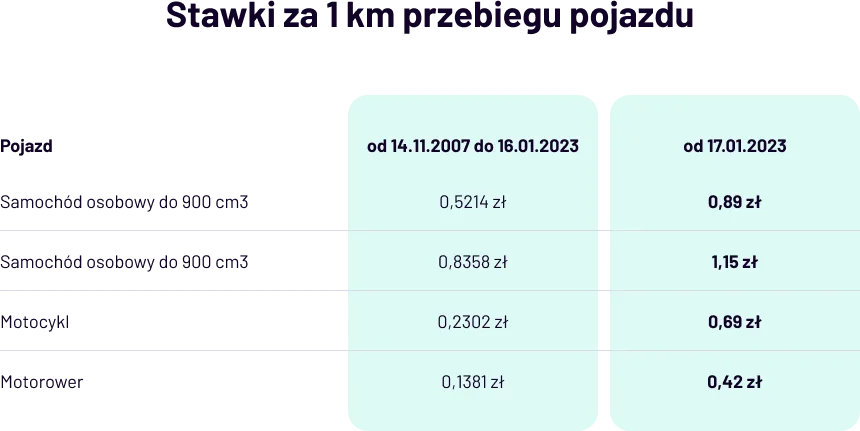
- Servicing and repair costs
The additional mileage from private kilometres can lead to greater wear on vehicles (parts, oils and consumables) and a more frequent need for servicing and repairs.
- Lower residual value of the vehicle (RV)
Mileage from private kilometres can accelerate vehicle wear, which affects its market value. High mileage can lower the vehicle's value when it is withdrawn from the fleet.
- Road tolls and parking fees
If an employee also uses a company car for private purposes, the employer may be liable for road charges such as motorway or bridge tolls (e-TOLL, SkyCash, AutoPay). In addition, parking costs when using paid car parks, car washes or other amenities during private journeys may also be included.
- Reduced availability of company cars
If employees also use company cars for private purposes, this can limit the availability of vehicles for business purposes. It is often the case that employees drive more kilometres privately than for business. In this situation, additional vehicles are often purchased or booking schedules planned to meet business needs.
Another availability problem is company cars being held by employees who do not use them at all. Unless the vehicle is treated as a benefit tied to the position, fleet costs can be optimised by introducing car pooling and reducing the number of cars.
- Accidental damage
If an employee also uses a company car for private purposes, there is a greater risk of road accidents or other damage to the vehicle. The employer may bear the repair costs as well as costs related to compensation claims, court proceedings or the insurance policy.
- Rental fee
In the case of leasing agreements, the rental instalment is based on an assumed mileage limit that covers both business and private driving. This means the fleet manager is exposed to excess mileage charges if employees persistently exceed the private mileage limit. It is therefore important to consciously factor in the costs of private mileage when negotiating fleet rental agreements.
- Fleet manager's time
Managing the documentation of employees' private mileage in the fleet, such as journey records, reporting and cost settlement, can generate administrative and bureaucratic costs. It is also an inefficient, significant investment of time which, despite the effort, does not make it possible to account for private journeys and refuelling at weekends, during holidays or on public holidays.
- Fleet policy
The need to develop and implement a policy on private mileage in the company fleet may involve costs related to drawing up documentation, training employees and maintaining the appropriate procedures.
- Private driving during working hours
Employees' private driving can lead to lost working time, especially if it involves long-distance journeys or takes place at times when the employee should be available at the workplace. The employer may bear costs related to lost productivity and the need to compensate the employee for lost time.
Methods of identifying and monitoring private mileage costs
Proper, long-term monitoring of these costs gives a better understanding of the impact of private mileage on the fleet's total cost of ownership and allows more informed decisions aimed at optimising spending and managing the vehicle fleet effectively. There are a number of methods and tools that can be used to identify and track the costs associated with private mileage.
The most popular solutions include:
- Keeping accurate driving logs
The employer can require detailed records of vehicle mileage to be kept, separating private and business kilometres. Driving logs should contain information on dates, routes and the purpose of journeys, which will allow more accurate monitoring and control of the costs associated with private kilometres.
Alternatively, a fleet management system can be used that automatically identifies private journeys while ensuring full anonymity and privacy for employees. Such applications often work on the basis of a schedule of working days and hours, which minimises the manual work required of drivers. Manual input from drivers is only needed to enter information about holidays or exceptional situations that deviate from standard working hours. This solution makes it possible to monitor and manage the costs associated with private kilometres while providing convenience and privacy for employees.
- Analysis of fuel and service invoices
Regular analysis of fuel and service invoices allows partial identification of the costs associated with private kilometres. Without appropriate telematics support, however, it is very difficult to spot all refuelling on days off, public holidays or "just in case". For example, without examining fuel consumption, if a driver fills up on a working day, Friday, and turns up on Monday with an empty tank, the irregularity will go unnoticed.
- Cost reporting system
Introducing a system for reporting costs associated with private driving will allow all costs related to fuel, repairs, road tolls and so on to be recorded and reported. This may include paper or electronic reporting forms that employees fill in and submit regularly. Its effectiveness depends largely on drivers' honesty.
- Implementing a fuel card system
A fuel card system can make it easier to track and control fuel costs. Employees receive special cards linked to the company account, which allows fuel consumption for business and private purposes to be monitored and reported. The system makes it easier to detect irregularities such as refuelling the car on days off.
- Review of the private mileage policy
Reviewing and updating the private mileage policy can help adapt the rules and guidelines to changing needs and regulations. Maintaining a clear and consistent policy makes it easier to identify and track the costs associated with private driving.
- Reporting working hours
If employees also use company cars for private purposes, reporting working hours can help monitor the time spent on private driving within working time. This makes it possible to track and manage employees' working time. An even more effective method is to use an app that lets the employee select the type of journey by switching between "private" and "business" mode. The app collects the data and allows accurate reports to be generated instantly.
- Review of the booking policy
If the fleet requires vehicles to be booked before use, the employer can monitor and analyse bookings to identify private driving. It is possible to check whether bookings were made during working hours or outside them, or whether cars were kept over the weekend or on days off, which may indicate private driving.
- Employee education
The employer can run training sessions and workshops for employees on the private mileage policy and cost reporting procedures. Educating employees can help raise awareness and responsibility for identifying and tracking costs.
- Using telematics systems to manage fleet costs
Specialist fleet management software offers modules for recording mileage, managing invoices and generating reports. Using these systems makes it easier to track and analyse the costs associated with private kilometres and to identify areas where savings can be made.
Modern technologies such as GPS systems and mobile apps are invaluable tools for monitoring and controlling the costs of private driving. GPS systems enable precise tracking of routes and journey times, which allows an accurate estimate of the costs associated with private kilometres. With them, fleet managers can get a fuller picture of the real costs and manage the fleet consciously, minimising the impact of private mileage on TCO.
Mobile apps, in turn, allow employees to easily record their private kilometres, which makes data collection and cost control easier. By using these tools consistently, fleet managers can meticulously monitor and analyse the costs associated with private driving, which allows them to identify areas where savings can be made.
Examining the cost efficiency of the vehicle fleet, including private driving, is an important step in optimising fleet management. Regular assessments make it possible to identify areas for improvement, observe the results of the measures introduced and compare costs with historical data or industry benchmarks. This enables continuous improvement of the fleet management strategy and minimisation of the impact of private mileage on the fleet's total cost of ownership.
Metrics for analysing the impact of private mileage on fleet TCO
When analysing the impact of private mileage on TCO, various metrics can be used to help assess costs accurately and optimise them. The most popular are:
- Cost per kilometre (CPK): CPK measures the average operating cost of a vehicle per kilometre driven. A higher CPK for vehicles with more private kilometres may indicate higher costs of running those vehicles. Comparing CPK across vehicles can provide important information on the impact of private kilometres on TCO.
- Economic cost ratio (ECR): ECR compares the TCO of different vehicles or fleets taking into account the level of private kilometres. This ratio allows an accurate comparison of cost efficiency and identification of areas where savings can be achieved. ECR analysis can provide valuable guidance on minimising the impact of private kilometres on fleet TCO.
2. Understanding the real impact of private mileage on fleet TCO
Understanding the real impact of private mileage on the fleet's total cost of ownership is key to making effective management decisions. Analysing data and statistics provides valuable information on how private driving can affect operating costs and fleet efficiency. We will use real, anonymised examples from our customers.
The impact of private mileage on fleet TCO: a case study
Our customer has a fleet of 290 vehicles. In April all these cars drove a total of 640,428.5 km. Of this, 63,540 km were driven on Saturdays and Sundays alone, which represented 10% private driving. In addition, 14,800 km (2.3%) were driven during holidays. Together, private kilometres accounted for 12.3% of the total. In this example, as many as 145 drivers exceeded the most common private mileage limit, which was 200 km.
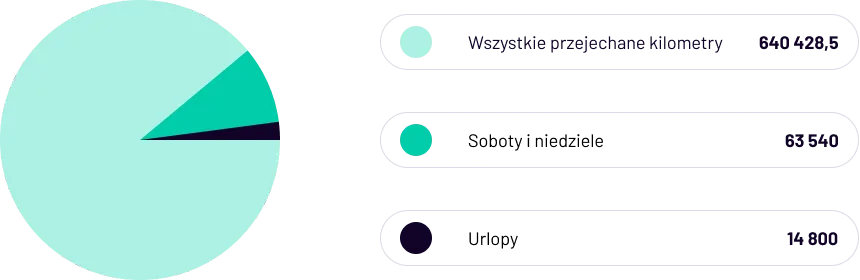
If the company introduced a free allowance for private kilometres (200 km) and charged for every additional kilometre, the total number of private kilometres above the limit would be 39,600 km. Even at a very favourable rate of PLN 0.50/km, the company could save around PLN 19,800 a month.
To get an even better picture of the cost of private driving in the company, let us analyse the monthly charges for individual vehicles. Let us assume that the cost of one vehicle in the fleet is PLN 2,500 a month, including the lease instalment, fuel, insurance and servicing. Multiplying this amount by the number of vehicles in the fleet (290) gives a total fleet cost of PLN 725,000 a month. If 12.3% of this amount, i.e. PLN 89,175, is generated by private driving, that is a significant expense for the company.
The example cited illustrates how significant an impact private kilometres have on fleet TCO. Introducing effective strategies and tools for managing private kilometres brings real savings and cost optimisation for companies. It may even turn out that the number of cars is inadequate to needs, because most of them are used for private rather than business driving. In that case, not only is buying more cars unnecessary, but the use of the existing vehicles can be optimised, for example by introducing car sharing. Our second customer managed a fleet of 4,700 cars and, by introducing the strategy discussed, achieved savings of 210 million and reduced the fleet to 2,000 cars.
3. Strategies for minimising the costs associated with private mileage
In professional fleet management there are two key perspectives on private mileage: one in which drivers are free to drive as they see fit, and another in which there are specific provisions regulating private driving, but enforcing them effectively can be a challenge. Whatever situation your fleet is in, a strategy for minimising the impact of private mileage requires clear arrangements whose observance will be monitored.
For a fleet in which drivers are free to drive as they see fit, building an effective strategy requires understanding drivers' motivation for using company vehicles for private purposes. It is then important to introduce appropriate provisions in the fleet policy. It is also important to provide clear guidelines on the use of company vehicles, including specifying the hours and days when their use is permitted, and to introduce tools that make it possible to monitor this. It may also include promoting alternative means of transport such as car pooling or public transport, or introducing initiatives that encourage drivers to limit private driving, for example reward and recognition programmes for drivers who stay within the set private mileage limit.
For a fleet that already has policy provisions regulating private driving, enforcing these rules effectively can be a challenge. It is important to provide the right tools and processes to monitor private kilometres without infringing drivers' privacy. Implementing a telematics system that automatically collects data on vehicle mileage and routes can be useful in this process. This way, fleet managers can receive regular reports and analyses of private kilometres, which enables effective monitoring and reporting.
Where fleet policy provisions on private driving already exist, effective enforcement requires a firm approach. It is important that fleet management and managers have the right support and tools to enforce the policy, such as GPS tracking, analysis of fuel and service invoices and review of regular private driving reports. It is also key to maintain clear procedures for dealing with policy breaches and to apply appropriate sanctions consistently to drivers who exceed the set private mileage limits.
In summary, building an effective strategy for minimising the impact of private mileage on fleet TCO requires considering different scenarios depending on the starting situation. Whether the fleet allows free private driving or already has policy provisions on private driving, it is important to monitor private kilometres without infringing drivers' privacy and to enforce the existing fleet policy provisions effectively. This makes it possible to minimise the costs associated with private kilometres and optimise the fleet's total cost of ownership.
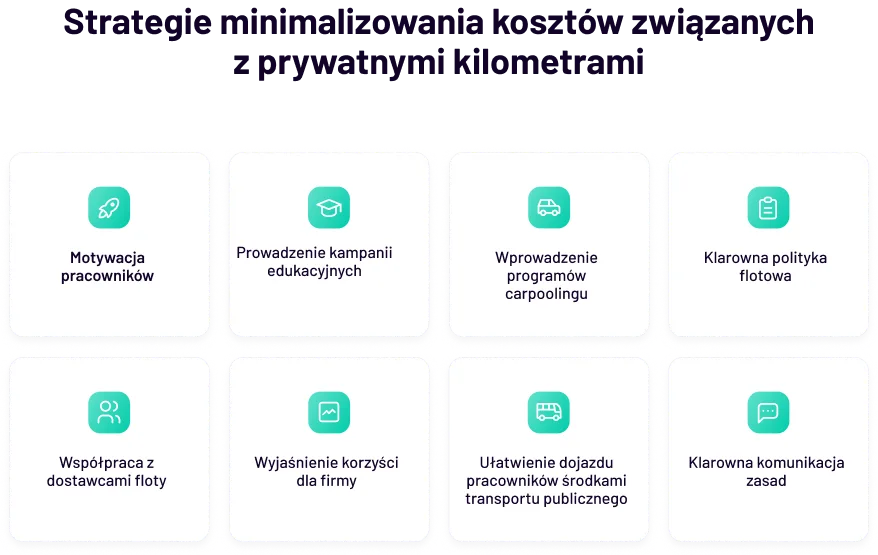
Important elements of an effective strategy for minimising the costs associated with private mileage:
- A clear policy on private mileage
Introducing a clear policy on private mileage is key to minimising its impact on TCO. The policy should define the rules for using company vehicles for private purposes and the limits on the amount and frequency of private kilometres. Example rules might include a capped monthly private mileage allowance or a requirement to report and justify every private journey. It is important that the policy is tailored to the problems observed, drivers' attitudes and their motivations. If you want to find out more about accounting for private mileage, see: How to account for employees' private journeys without surveillance?
- Motivating employees to limit private mileage
Creating a system of rewards or benefits for employees who actively limit private mileage is an effective strategy. These can be bonus programmes, additional benefits for employees who keep private mileage low or use alternative means of transport for private purposes, as well as gamification. This is an important element in building a lasting change in attitudes to private mileage in the company.
- Explaining the benefits to the company of minimising private mileage
Employees should understand how minimising private mileage helps reduce costs for the company. Explaining the benefits, such as lower fuel, servicing and insurance costs, can be a strong motivation for employees to use company vehicles more consciously. Information about the savings that can be achieved by minimising private mileage, such as lower fuel consumption, lower servicing and repair costs and lower insurance costs, can encourage employees to engage actively in the minimisation strategy. As a result of fleet savings, the company budget can be used in other ways, for example as additional funding for other kinds of employee benefits.
- Tips for running educational campaigns and communicating with employees about the use of company vehicles
It is important that employees are aware of the impact of private mileage on fleet TCO and the benefits of minimising it. Running educational campaigns and transparent communication can help highlight these issues and encourage employees to use company vehicles more responsibly. Information meetings can be organised, educational materials provided, and regular communication with employees maintained to keep awareness and engagement high.
- Organising training on the optimal use of company vehicles
Training on the optimal use of company vehicles can provide practical tips on saving fuel, looking after vehicles and avoiding unnecessary journeys. Employees should be aware of economical driving techniques, regular vehicle servicing and the use of alternative means of transport where possible. Training can be delivered by fleet experts or driving instructors who will pass on practical tips and best practice.
- Making it easier for employees to commute by public transport
Companies can support employees in using public transport by concluding agreements with local operators and providing tickets or additional discounts. These measures can encourage employees to limit private mileage and help reduce fleet costs. Employees can also be offered perks such as dedicated parking spaces for those who use public transport.
- Introducing car pooling and vehicle sharing programmes
Introducing car pooling and vehicle sharing not only significantly reduces fleet costs but also increases the efficiency of use of the existing vehicles. The company avoids having to buy additional cars while providing everyone who needs one with a company means of transport.
- Working with fleet suppliers
The employer can work with fleet suppliers such as petrol stations, garages and car rental companies to reduce the number of abuses.
Adopting a strategy for minimising the costs associated with private mileage leads to effective fleet management, lower TCO and optimised fleet ownership costs.
4. Technologies supporting the management of private mileage
Managing the costs of private driving within a fleet effectively requires the use of innovative technological solutions that enable private kilometres to be monitored, managed and controlled. In this section we present various technologies that can support the management of private mileage, and discuss their functions, benefits and the potential challenges of implementing them.
GPS systems and reading data from vehicles
GPS systems are an irreplaceable tool for monitoring routes and journey times. They make it possible to determine precisely which routes were driven for private purposes, enabling an accurate estimate of the costs associated with private kilometres. In addition, GPS in a company car can provide information on driving speed, fuel consumption and other factors affecting fleet efficiency, while protecting the driver's privacy. The system monitors the route, but without locating the car.
Mobile apps for recording and reporting private mileage
These apps often integrate with vehicle telematics systems to provide precise, automatic tracking of kilometres driven, without involving drivers. This allows fleet managers to instantly identify and allocate the costs associated with private journeys. Instead of relying on manual data entry and tracking fuel receipts, these apps automate the process while providing accurate, up-to-date data and saving time for both the fleet manager and the driver.
Overview of the technological solutions available on the market
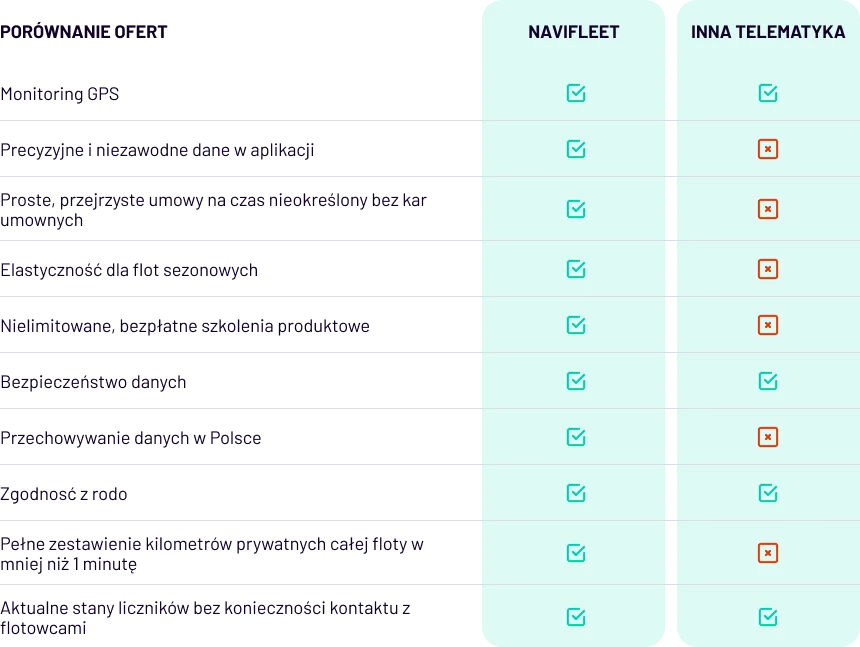
Personal data protection in fleet management systems: GDPR compliance
With the introduction of new technologies supporting the management of private mileage, it is also important to protect personal data in line with the requirements of the General Data Protection Regulation.
When implementing technologies that monitor private driving, compliance with GDPR principles must be ensured, such as employees' consent to data processing, the right of access to their own data, restrictions on data processing to minimise the risk of privacy breaches, and appropriate technical and organisational safeguards that protect personal data from unauthorised access or loss.
It is also important to inform employees of the purpose of processing their personal data relating to private mileage, the scope of the data collected and how it is used. Employees should be aware that their privacy is protected and that the data processed serves only the purposes of fleet management and cost minimisation.
When implementing technologies supporting the management of private mileage, it is worth working with suppliers and service providers that provide appropriate safeguards and comply with GDPR requirements. Before entering into cooperation, carefully examine the privacy policy and the safeguards used by suppliers to make sure they meet the legal requirements.
By complying with GDPR principles and protecting personal data, organisations can build employee trust and maintain a high level of security in processing data on private mileage. Protecting employees' privacy and GDPR compliance are an important aspect of effective fleet management and minimising the impact of private mileage on TCO.
5. Implementing effective private mileage management in practice
Implementing effective private mileage management in practice is a key challenge for organisations managing vehicle fleets, regardless of their size. Only a comprehensive approach that takes into account various aspects, from fleet policy to data monitoring and rule enforcement, is effective. Bringing about lasting change in the approach to private mileage also requires the right tools, such as the business and private mileage report.
Practical tips for implementing strategies and tools for managing private mileage
From choosing the right mobile apps, through implementing telematics technology, to developing policies and procedures that help regulate the private use of company cars, we offer practical tips that can help in the effective implementation of strategies and tools for managing private mileage.
Every company is different, but there is a set of universal good practices that can be adapted to the individual needs of the organisation:
- Setting goals
Define clear goals you want to achieve through private mileage management. These may be cost reduction, improved fleet efficiency, greater availability of company vehicles or compliance with the fleet policy. The goals should be measurable and tailored to the specifics of the organisation.
- Developing a fleet policy
Create a fleet policy that clearly defines the rules and expectations regarding the use of company vehicles and private driving. The policy should cover aspects such as the permitted scope of private kilometres, procedures for reporting private journeys, ways of measuring compliance with the agreed rules and sanctions for breaching the policy.
- Choosing the right tools
Identify technological tools that can help monitor and manage private mileage. GPS systems, mobile apps and telematics reporting platforms enable detailed data to be collected and the costs associated with private kilometres to be analysed.
- Employee education
Run training for employees on the fleet policy, procedures for reporting or monitoring private journeys and the use of dedicated tools. Make employees aware of the importance of minimising the impact of private mileage on fleet TCO and encourage them to participate actively in the management process.
- Regular monitoring and reporting
Ensure regular monitoring of private mileage data and preparation of reports. Analyse the information collected, identify areas where improvements can be made, and adjust the policy and private mileage management strategies based on the results of the analyses.
- Enforcing the fleet policy provisions
In practice, even the most coherent and clearly defined fleet policy may be insufficient if there is no effective way of enforcing it. This is where the need arises for effective monitoring methods that will make it possible to control the costs of private driving and minimise their impact on fleet TCO.
- Analysis of the costs associated with private mileage
Cost analysis is a key element of monitoring the impact of private mileage on fleet TCO. It should cover both direct costs, such as fuel consumption, servicing costs and vehicle depreciation, and indirect costs, such as employees' working time and efficiency. By carefully tracking and analysing these costs, it is possible to identify areas where savings can be achieved by minimising private mileage.
- Measuring fuel consumption
Fuel consumption is one of the biggest costs of running a vehicle fleet. That is why monitoring and reporting fuel consumption is key in the context of private mileage. There are specialist tools and systems that allow the amount of fuel consumed to be measured accurately based on data from the vehicles. By analysing this data, it is possible to identify vehicles or employees that generate high fuel costs related to private mileage. See a sample vehicle performance comparison report or a sample vehicle mileage record report.
- Analysing routes and journey times
Accurate monitoring of routes and journey times is important when analysing the impact of private mileage on fleet TCO. GPS systems make it possible to record routes, distances and journey times precisely. This allows the efficiency of routes to be assessed and unnecessary, long private kilometres to be identified. Analysing this data can lead to route optimisation and lower costs associated with private mileage. See a sample point visit report.
In summary, establishing a watertight fleet policy is the first step towards minimising the impact of private mileage on fleet TCO. Equally important, however, is introducing effective monitoring methods such as GPS systems and mobile apps, and educating employees. This way, fleet managers will have a fuller picture of the costs associated with private driving and will be able to make informed decisions to optimise fleet TCO.
Defining goals and success indicators
When choosing technologies to support private mileage management, it is important to define specific goals and success indicators. It is important to tailor them to the specific needs and goals of the organisation. The technological capabilities and the availability of data for monitoring them should also be taken into account.
Below are a few potential goals and indicators that can be considered:
- Reducing the costs associated with private driving: The goal may be to reduce the total costs associated with private mileage. The success indicator may be the percentage reduction in these costs over a given period.
- Improving fleet efficiency: The goal may be to increase fleet efficiency by optimising routes, minimising fuel waste and reducing unnecessary kilometres. The success indicator may be an improvement in the average cost per kilometre or the average fuel consumption per kilometre.
- Compliance with the fleet policy: The goal may be to ensure that private driving takes place in accordance with the defined guidelines and fleet policy. The success indicator may be the degree of employee compliance with the fleet policy.
- Time and operational efficiency: The goal may be to increase the time and operational efficiency of the fleet, as well as the fleet manager's working time. The success indicator will be a reduction in the amount of time spent on a given task.
- Availability of company vehicles: The goal may be to ensure adequate availability of company vehicles for employees, minimising cases of unavailability due to too many private kilometres. The success indicator may be the percentage of time vehicles are available for business needs.
- Knowledge of the number of private kilometres driven: The goal may be to give the fleet manager full knowledge of the number of private kilometres generated within the fleet. This information is crucial as a starting point for further optimisation and can help in making decisions about the private mileage management strategy. The success indicator in this case may be the precision and currency of the data collected on private kilometres driven.

6. Checklist for effective private mileage management in a vehicle fleet
- Collect data on private driving in the fleet:
- Determine the number of employees who have access to company cars.
- Identify the frequency and purpose of using company cars for private purposes.
- Assess the costs associated with private driving (e.g. fuel, running costs, insurance).
- Prepare a private driving policy:
- Create a fleet policy that clearly defines the rules and expectations regarding the use of company vehicles and private driving.
- The policy should cover aspects such as the permitted scope of private kilometres, procedures for reporting private journeys and sanctions for breaching the policy.
- Make sure the policy is consistent with the applicable legal regulations, including GDPR principles.
- Communication and employee education:
- Run training for employees on the fleet policy, procedures for reporting and monitoring private journeys and the use of dedicated tools.
- Make employees aware of the importance of minimising the impact of private mileage on fleet TCO and encourage them to participate actively in the management process.
- Run training to ensure employees are aware of the rules and restrictions on private driving.
- Choosing the right technological tools:
- Identify technological tools that can help monitor and manage private mileage, e.g. GPS systems, mobile apps, telematics platforms.
- Make sure the tools chosen are compatible with your fleet's needs and provide an appropriate level of personal data protection.
- Data analysis and monitoring results:
- Regularly analyse data on private driving in the fleet to assess the effectiveness of the measures introduced.
- Track savings and changes in the use of company cars for private purposes.
- Analyse the information collected, identify areas where improvements can be made, and adjust the policy and private mileage management strategies based on the results of the analyses.
- Setting goals:
- Define clear goals you want to achieve through private mileage management, e.g. cost reduction, improved fleet efficiency, compliance with the fleet policy.
- Make sure the goals are measurable and tailored to the specifics of your organisation.
By implementing these steps, you will have a comprehensive approach to managing private mileage in your fleet, which will allow you to achieve your goals and minimise costs.



