
For some time now the latest second-generation smart tachograph has been a topic attracting heightened interest in the transport industry. Why is so much attention being paid to this modern device? On 21 August 2023 the European Union introduced the Mobility Package rules, which require all newly registered trucks engaged in international transport to be fitted with new-generation smart tachographs (also known as new second-generation smart tachographs, G2V2). This obligation also covers vans with a GVW above 2.5 tonnes. Importantly, the changes introduced apply only to international transport; they do not apply to domestic carriage.
Since the second-generation tachograph has already become an integral part of the equipment of vehicles with a GVW above 3.5 tonnes, and in time will also be an important part of vans used for international transport, it is worth taking a closer look at the characteristics of this device. In the rest of this article we explain, among other things, by when the replacement of tachographs with smart ones will have to take place across the whole international transport sector, how to recognise a second-generation tachograph and what distinguishes it from older types of device, and how much such a solution can cost.
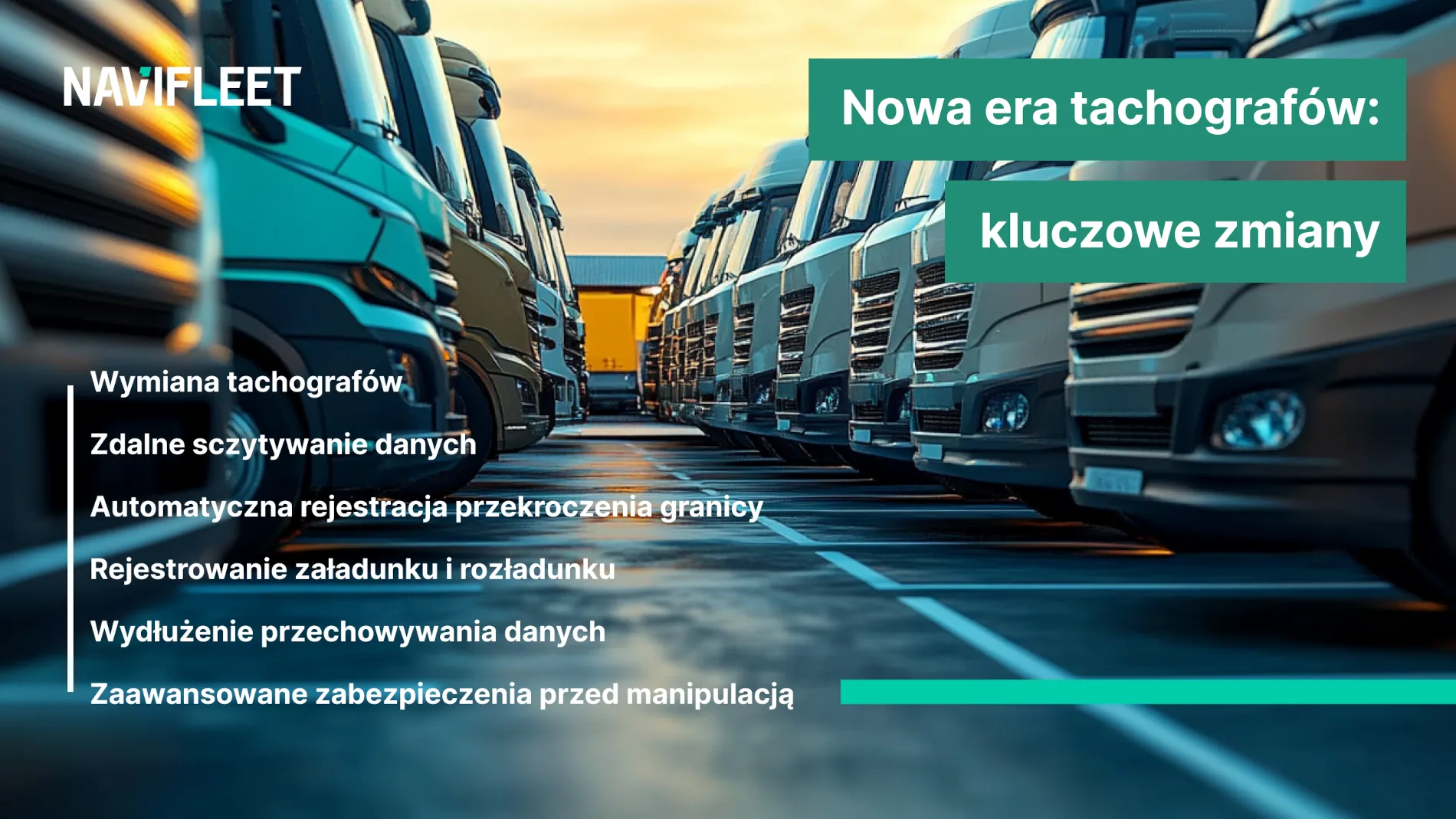
The second-generation smart tachograph: an important innovation in the transport industry
Under EU rules, the obligation to replace tachographs by 31 December 2024 covered not only new vehicles but also trucks registered before 15 June 2019 fitted with analogue or older digital tachographs (G1, G2V1). Later, the G2V2 smart tachograph also became mandatory equipment for vehicles registered up to 21 August 2023. Compliance with the new requirement was policed by the competent authorities: the Road Transport Inspectorate and the police imposed (and still impose) penalties on transport companies and transport managers for vehicles that do not meet the new requirements.
Smart tachographs: from when do they have to be fitted in vehicles?
From when did the latest-generation smart tachographs become a necessity for vehicles engaged in international transport? It is not possible to give a single specific date, because this change was introduced gradually. The easiest way to follow the process of mandatory transition from older devices to second-generation smart tachographs is the timeline below:
- by 28 February 2025 (transition period; original date: 31 December 2024)
Road hauliers carrying out international transport within the EU with trucks with a GVW above 3.5 tonnes registered before 15 June 2019 had to replace all old recording devices, such as analogue tachographs or previous digital tachographs, with second-generation smart tachographs by 31 December 2024. The European Commission, in cooperation with the member states, agreed a transition period running until 28 February 2025, thereby extending the deadlines imposed earlier.
- by 18 August 2025
Trucks carrying out international transport that were fitted with first-generation smart tachographs (G2V1) and registered between 15 June 2019 and 21 August 2023 had to be upgraded by that date to meet the requirements for a second-generation smart tachograph (G2V2).
- by 1 July 2026
From that point the obligation to use a second-generation smart tachograph also covers vehicles with a gross vehicle weight above 2.5 tonnes, such as vans, engaged in international transport.
How does the smart tachograph 2.0 differ from older recording devices?
The new rules require older recording devices to be replaced with second-generation G2V2 smart tachographs. In addition, drivers are now required to carry data for a longer period: it has been increased from the previous 28 days to 56 days. This means drivers must have with them data from the last 56 days, covering both the information stored on the driver card and supplementary documentation such as printouts, explanations or inspection reports. These additional elements are necessary so that an inspector can verify situations that are not directly visible in the tachograph records, such as breakdowns, rest taken away from the vehicle or changes to the schedule.
When it comes to what the latest G2V2 smart tachographs are like, it is worth mentioning that they offer more functions than devices of previous generations. Among these new features, automatic recording of the time and location of border crossings deserves a special mention. What is more, the smart tachograph 2.0 has also been improved in terms of protection against data manipulation, such as attempts to use magnets or switches. Note also that with second-generation smart tachographs drivers can continue to use their existing cards, as long as they are valid and meet the current legal requirements.
To better understand what characterises a second-generation smart tachograph and how it differs from its predecessors, let us analyse a few important new features it offers users.
Remote data reading (DSRC)
The starting point is the fact that with the introduction of the new generation of recording devices, the competent authorities have gained expanded capabilities for reading a smart tachograph without stopping the driver. G2V2 smart tachographs are fitted with a DSRC (Dedicated Short-Range Communication) system with a longer communication range, which enables data to be sent remotely from the tachograph to the inspection device. This allows inspectors to check a vehicle from a greater distance without having to stop it. It is a much faster and more effective method of identifying infringements, which leads to fewer random stops and saves drivers time.
Automatic recording of border crossings
In older tachographs, the driver had to enter the country code manually after crossing a border. This required stopping the vehicle and was an additional duty. Operating a second-generation smart tachograph is much more convenient in this respect. Thanks to the implementation of a modern GNSS (Global Navigation Satellite Systems) system, the device automatically records the moment of crossing the border. What is more, it also updates the time zone if it changes.
Recording loading and unloading
First-generation tachographs had no function for recording detailed data on loading and unloading locations. In second-generation devices this option is now available. The driver has the option of manually marking the working mode, including unloading and loading, and indicating the exact location, such as a warehouse or terminal.
Easier communication with fleet management systems
When discussing the operation of second-generation smart tachographs and the new conveniences associated with them, it is also worth noting that the new recording devices, for example those made by VDO, have built-in interfaces: ITS and Bluetooth. They enable smooth communication with fleet management and telematics systems. This makes possible, among other things, automatic data download according to an agreed schedule and real-time monitoring of the driver's working time.
How to recognise a second-generation smart tachograph?
How can you tell in practice that you are dealing with the latest second-generation smart tachograph? One way is by checking the recording device's rating plate or label, which shows its model and serial number. Alternatives include consulting the tachograph's user manual and verifying the features it offers.
Replacing a tachograph with the latest device: how much does a G2V2 smart tachograph cost?
The purchase price of a second-generation smart tachograph ranges on average between around PLN 3,000 and 5,500. Bear in mind that, in addition to the cost of buying a device from a proven manufacturer such as VDO or Stoneridge, the carrier must also be prepared for expenses related to the installation and calibration of the new equipment and other matters arising from its use.
What are the penalties for not having a second-generation tachograph?
Replacing older tachographs with the latest second-generation smart devices is an obligation for carriers. For failing to comply, the inspecting authorities can impose severe penalties. A vehicle travelling without the appropriate recording device carries the risk of, among other things:
- a fine for the driver of up to PLN 2,000,
- a penalty for the transport manager of up to PLN 2,000,
- a penalty of up to PLN 10,000 for the carrier.
It is worth adding that financial penalties for this type of infringement differ from country to country and can reach really high amounts.
Second-generation smart tachographs: a step towards automation and more effective inspection
The introduction of second-generation smart tachographs under the EU Mobility Package has increased the inspection capabilities of services such as the Road Transport Inspectorate and the police. The new devices enable remote data reading, allowing faster and less invasive checks without the need to stop vehicles. Automatic recording of border crossings and the ability to record loading data make it easier to monitor compliance with international transport rules. In addition, extending the data retention period from 28 to 56 days and advanced anti-tampering safeguards increase the effectiveness of detecting infringements.
Modern second-generation smart tachographs can make life easier not only for the inspection services, but also for carriers, fleet managers and drivers. Especially when they work with a modern system such as Navifleet, which makes fleet management in a transport company much more convenient. The Navifleet system offers many useful features, including remote download of driver cards and tachograph memory, which allows automated data download according to a set schedule and without having to bring the vehicle back to base, and driver working time control, which lets you monitor many parameters on an ongoing basis, including, for example, how much longer a given driver can still drive on a given day without committing an infringement.
Interested in tachographs and want to learn more about these devices? We encourage you to read the other articles about them on our blog, including:
- Downloading Driver Card Data: The Key to Compliance and Efficiency in Transport
- How to streamline the settlement of drivers' working time? A guide to remote tachograph data download
- How to control driver working time norms with GPS tracking?
- Tachograph: what it is, how it works, what it is for and who must have one
- How to insert a card into a tachograph? A practical step-by-step guide
- Driving without a tachograph: when is it allowed?
- Tachograph breakdown: what to do in such a situation?
 Agata Świerczek
E-marketing Specialist
As a UX/UI design specialist I combine creativity with precise communication. I design intuitive interfaces and engaging digital content, and I write product copy and blog articles that hold attention and support business goals.


