This article covers Polish regulations and market practice. The principles apply elsewhere, but check the rules in your country.
Vehicle usage records are an issue that plays a very important role in managing a company fleet. Why? Vehicle mileage records, known in Poland as the "kilometrówka", allow you to record the expenses incurred in running vehicles used for business purposes. These can later be deducted as tax-deductible costs. For this reason, properly kept mileage records are of considerable importance to businesses.
When is a business required to keep vehicle mileage records?
When do you have to keep a mileage log? Many business owners wonder whether vehicle usage records are mandatory in their case. So let us take a closer look at the situations in which a regular mileage log turns out to be a necessity.
Vehicle mileage records are used mainly for passenger cars and motorcycles. These belong to the group of vehicles which, under the VAT Act, can be used both for business purposes and for private purposes.
Depending on how the vehicle is used, different tax deduction criteria apply. If it is used for mixed purposes (that is, privately and for business), only part of the VAT can be deducted. If the vehicle is used exclusively for business purposes, 100% can be deducted. In the latter case, however, the Act imposes certain obligations on the owner of the vehicle, including registering the vehicle on the VAT-26 form and keeping vehicle mileage records (a mileage log).
Where does the obligation to record vehicle mileage come from? Mileage records must be kept to prove that the vehicle is used exclusively for business purposes. The Tax Office has the right to inspect the mileage log, checking for inconsistencies that would indicate the vehicle was also used privately, that is for purposes unrelated to the business.
Are mileage records necessary for a business owner's private cars?
Since 2019 there has been no need to keep mileage records for a business owner's cars that are used for private purposes. For these, up to 20% of expenses can be deducted without having to complete a mileage log. The situation is similar for cars used in a business under short-term rental or a loan-for-use agreement: in this case 75% of expenses can be treated as business costs.
Company vehicle mileage records: which running costs can be deducted from tax?
Properly kept mileage records for company vehicles make it possible to deduct certain expenses from tax. Which group of costs is this? It covers all expenses related to running the vehicles.
Expenses that can be deducted from tax include:
- fuel,
- screenwash,
- necessary repairs,
- servicing,
- motorway tolls.
Which expenses, on the other hand, cannot be treated as vehicle running costs and consequently deducted from tax? Running costs do not include, for example, spending on modifying or upgrading the vehicle, such as fitting an LPG system.
What must vehicle mileage records for VAT purposes contain?
How do you keep vehicle mileage records for VAT purposes correctly? The basic thing to take care of is making sure they contain all the information specified in the regulations. What data should VAT mileage records include?
Under the provisions of the VAT Act, vehicle mileage records should contain:
- the vehicle's registration number;
- the day the records were started and ended;
- the vehicle's odometer reading on the day the records were started,
- at the end of each accounting period and on the day the records were ended;
- an entry by the person driving the vehicle for each use of the vehicle, including:
- the consecutive entry number,
- the date and purpose of the journey,
- a description of the route (from – to),
- the number of kilometres driven,
- the name of the person driving the vehicle,
- the number of kilometres driven at the end of each accounting period and on the day the records were ended.
Mileage records: how to fill in the log when the car is made available to someone from outside the company?
If the vehicle is made available to someone who is not an employee of the taxpayer, the relevant entry should be made by the person lending the vehicle. In this situation the entry includes:
- the consecutive entry number,
- the date and purpose of making the vehicle available,
- the odometer reading on the day the vehicle was made available,
- the number of kilometres driven,
- the odometer reading on the day the vehicle was returned,
- the name of the person the vehicle was made available to.
What should company vehicle mileage records look like? Ways of keeping a mileage log
How to keep a mileage log in line with the regulations? The Act does not specify the form in which vehicle mileage records must be kept. From a legal point of view, what matters is only that they contain all the required elements listed above. Company vehicle records can be kept either electronically or the "traditional" way, on paper.
Keeping a mileage log for VAT purposes on paper is hard to regard as optimal, however, especially if the company has a whole fleet of vehicles. In that case it is easy to make mistakes or lose important information, and keeping the records becomes an exceptionally time-consuming task. Creating electronic files or spreadsheets is a better option, but still not ideal. Vehicle usage records can be kept far more efficiently when the company has the support of professional fleet management software.
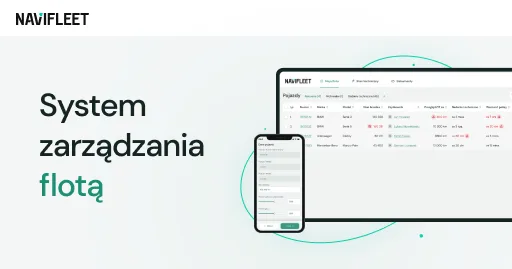
One such solution is the innovative Navifleet system, which allows a company to always have a well-organised fleet scheduler and all its documents gathered in one place, among other things. Vehicle records are created in it almost automatically: the relevant information is saved by the system in reports on an ongoing basis. This saves time, makes it quick to find information and reduces the risk of errors. The Navifleet fleet management system is therefore an effective way of optimising the process of recording company vehicle mileage.
Vehicle mileage records: how to fill them in correctly?
How to fill in vehicle mileage records? The information on the purpose of the journey, the description of the route and the number of kilometres driven is meant to certify that the car is used for business. That is why company vehicle records should contain a detailed description of the purpose of the journey, so that it can be proven the route was driven for business purposes. Descriptions that are too brief, such as "supplies" or "business trip", may be challenged. Examples of correct entries when keeping vehicle records include "collecting supplies from wholesaler X" or "business meeting with client Y".
When considering how to fill in a mileage log, note that describing the route too generally is also a mistake, for example "journey from town A to town B". The safe option is to give the exact address. Without it, recording kilometres becomes much more difficult, because there is no way to accurately estimate the number of kilometres that should have been covered on the route. As a result, it cannot be clearly established whether the car was used for private purposes in the meantime.
To sum up: how should company vehicle mileage records be filled in? In detail and precisely: writing down the details will prevent later difficulties in proving that the vehicle was used exclusively for business purposes.
What to do if there are gaps in the vehicle records?
It may happen that company vehicle records contain gaps, for example because employees forgot to fill them in. In such a situation, to avoid problems with the Tax Office, in the month in which the vehicle running cost records were not kept correctly, only 50% of the costs should be deducted from tax.
Change in per-kilometre rates in 2023: what employers and employees should know
On 2 January 2023 the Journal of Laws (item 5) published the regulation of the Minister of Infrastructure of 22 December 2022 amending the regulation on the conditions for determining and the method of reimbursing the costs of using passenger cars, motorcycles and mopeds not owned by the employer for business purposes.
This amends the regulation of the Minister of Infrastructure of 25 March 2002 on the conditions for determining and the method of reimbursing the costs of using passenger cars, motorcycles and mopeds not owned by the employer for business purposes (Journal of Laws item 271, as amended). The main change is an adjustment of the rates per kilometre driven.
The regulation came into force on 17 January 2023. The new rates per kilometre driven are as follows:
1. for a passenger car:
- with an engine capacity of up to 900 cm3 – PLN 0.89,
- with an engine capacity above 900 cm3 – PLN 1.15;
2. for a motorcycle – PLN 0.69;
3. for a moped – PLN 0.42.
The parties to whom the above per-kilometre rates apply have not changed. Under § 1 of the aforementioned regulation of the Minister of Infrastructure of 25 March 2002:
1. Reimbursement of the costs of an employee's use of passenger cars, motorcycles and mopeds not owned by the employer for local business journeys, hereinafter "vehicles for business purposes", takes place on the basis of a civil law agreement concluded between the employer and the employee on the use of the vehicle for business purposes, on the terms set out in the regulation.
2. Reimbursement of the costs of an employee's use of a vehicle for business purposes outside the locality where the employer's registered office is located, or outside the employee's regular place of work, is governed by the provisions on the detailed rules for determining the amounts due to an employee in respect of domestic business travel.
What are the current mileage limits for local journeys?
It is also worth mentioning that the above regulation governs the mileage limits for local journeys. The specific limit is still set by the employer, but it may not exceed the following values (depending on the number of inhabitants of the city or municipality):
- 300 km – up to 100,000 inhabitants,
- 500 km – over 100,000 to 500,000 inhabitants,
- 700 km – over 500,000 inhabitants.
Different mileage limits apply to the forest service and other emergency services.
Vehicle usage records: summary
What are vehicle mileage records? They are an accounting document that presents a detailed history of journeys and is essential for deducting VAT in full. So it is worth taking care of them to reduce the costs of running the business. Drivers' journeys can be recorded in various ways. What matters to the tax official is that all journeys appear in the log, while vehicle usage records kept electronically (an e-mileage log), for example through an app, are undoubtedly the most convenient and effective tool.
A proven solution that optimises fleet management, including the recording of vehicle running costs in a company, is the intuitive Navifleet system. To get to know its full capabilities, we encourage you to check the page presenting the pricing of services and features. Fleet records with Navifleet become more convenient and effective, helped by modules such as:
We also encourage you to read other useful articles on our blog, including:
- Business or private mileage? Use of company vehicles
- How to implement telematics in a fleet, step by step
- How does private mileage affect fleet TCO?
- How does an eTOLL tracker help with efficient fleet management?
- Monitoring fuel consumption in a car: how to reduce costs in a company?
 Agata Świerczek
E-marketing Specialist
As a UX/UI design specialist I combine creativity with precise communication. I design intuitive interfaces and engaging digital content, and I write product copy and blog articles that hold attention and support business goals.